


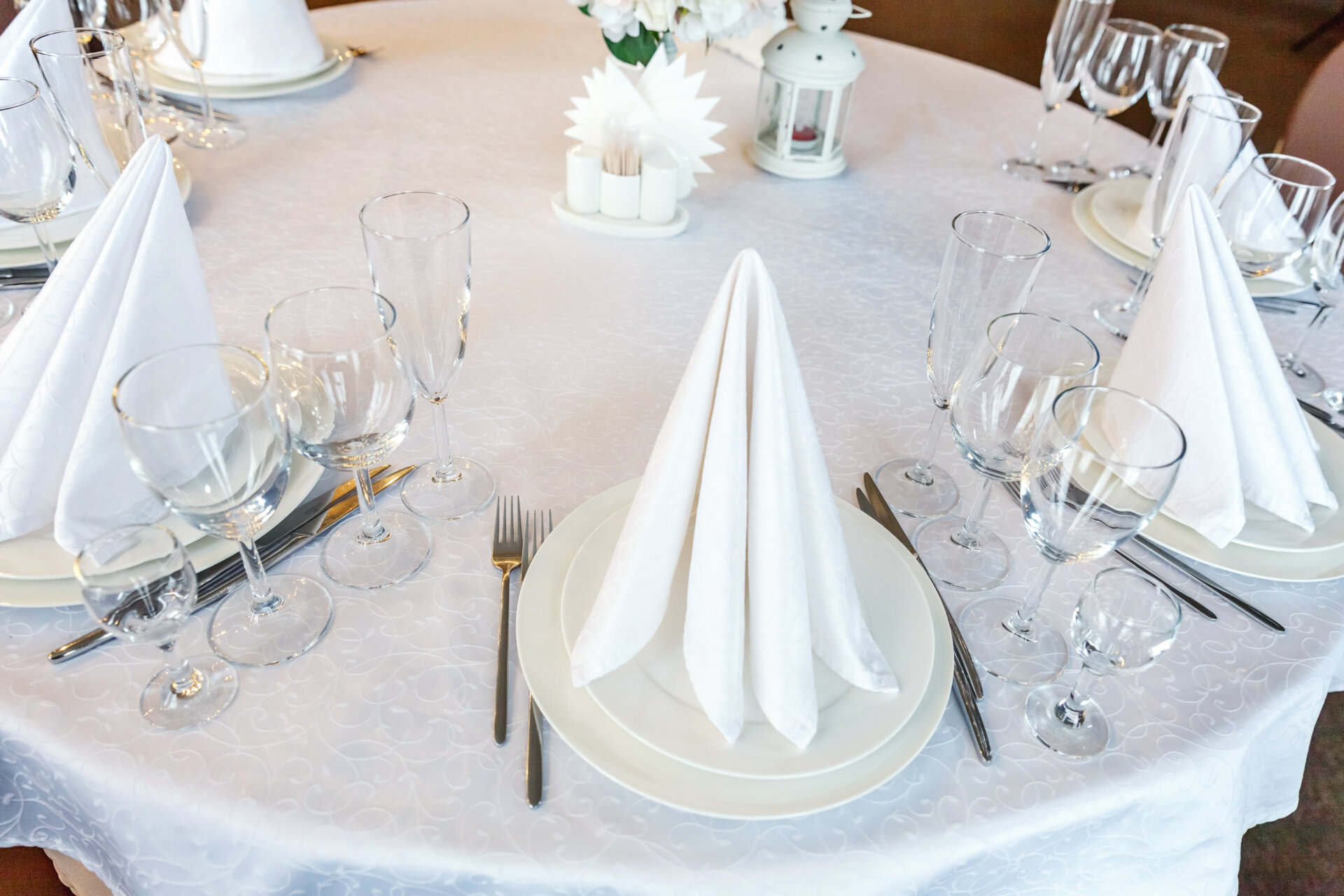
You want cheap party linens that won’t make your tables look like a church-basement bingo night. Short answer: for most parties with more than a handful of tables, renting fabric cloths costs less than buying decent ones, and you can trim the bill further by covering only the tables guests really see and ordering sizes on purpose. Buying cheap still makes sense in a few cases, and we’ll be honest about which.
We’ve been dressing party tables out of Brooklyn for more than 25 years. Here’s what actually saves money and what only looks like it does.
The Bargain Tablecloth Costs More Than Its Price Tag
A discount polyester tablecloth looks like a steal online. Then it arrives folded into a square the size of a paperback, with creases you’ll be steaming at midnight before the party. Afterward it needs washing and drying, plus a home in an apartment that already lacks a linen closet. And the size you guessed at is often a few inches off, so the drop is uneven or the cloth puddles on one side.
Rented tablecloths are sized to your tables and go back when the party’s over. Not owning them afterward is most of the savings. We make the broader case in our piece on renting vs. buying event equipment, but linens are where it shows most, because fabric you own keeps asking for pressing, washing and shelf space long after the guests leave.
Buying does have a real case. Here’s how it shakes out if you go that route.
Pros
- You keep them for the next birthday, holiday or game night
- No count to check or bag to fill at pickup
- Plastic disposables are fine for a kids’ party where frosting on the table is guaranteed
- Pays off if you host the same size party several times a year
Cons
- Fabric needs pressing before and laundering after
- Sizing guesses online lead to short drops or uneven hems
- Thin plastic tears and blows off outdoor tables
- Colors rarely match across brands, or even across two orders from the same seller
- Storage, which in New York is its own expense
If you live in the left column, buy and don’t look back. For a wedding, shower, bar mitzvah or milestone birthday with a room full of tables, linen rentals tend to win on cost once you count your time and your closet space.
Either way, the cheapest linen is the one you didn’t need to order. That’s where the bigger savings are.
Seven Ways to Cut the Linen Bill
Cover the tables guests look at
Guest tables, the buffet, the bar front, the dessert table and the gift table. That’s usually the whole list. The folding table behind the kitchen door holding backup soda doesn’t need a floor-length cloth. Nobody photographs the table holding the extra ice.
Pick the drop length on purpose
The drop is the stretch of fabric that falls below the tabletop on each side, and it’s the number that decides which cloth size you order. Traditional tablecloth guidance ties it to the table and the fabric: long tables carry a longer overhang, small tables look right with a short drop, and heavier fabric hangs differently from light. For a party you’re usually choosing between lap length (about 15 inches) and floor length (a 30-inch drop on a standard 30-inch-high table).
- 60-inch round: a 90-inch cloth gives a 15-inch drop (60 + 15 + 15). A 120-inch cloth reaches the floor (60 + 30 + 30).
- 6-foot banquet table (30 x 72 inches): 60 x 102 for lap length, 90 x 132 to the floor.
- 8-foot banquet table (30 x 96 inches): 60 x 126 for lap length, 90 x 156 to the floor.
Shorter cloths generally cost less to rent or buy, and the fabric difference isn’t small: a 90-inch round has a little over half the area of a 120-inch one. The trade-off is that lap length shows table legs and whatever’s stashed underneath. At a cocktail-style party nobody cares. At a seated wedding dinner, floor length on the head table is usually worth the money.
Seat more people per table
Fewer tables means fewer cloths. A 60-inch round has about 188 inches of edge, so eight guests get roughly 23 inches each, which is comfortable. Squeeze ten around it and each person gets under 19 inches, which is elbow wrestling. A 72-inch round has about 226 inches of edge, so ten guests get about 22 to 23 inches each.
For 100 guests, that’s thirteen 60-inch rounds (104 seats) or ten 72-inch rounds (100 seats). Three fewer cloths and three fewer centerpieces, though each floor-length cloth for a 72-inch table is bigger (132 inches across), so ask for both quotes. Bigger tables also eat more floor, so run the numbers on how much space per guest your room can give before you commit.
Let a few tables go bare
Some tables are meant to be seen. A row of rustic wood tables looks finished with a runner down the middle or nothing at all, and a few Paris cafe table and chairs sets give a cocktail corner its own look without a single cloth. Mixing in bare tables cuts the count and breaks up a sea of white.
Use one base color and change the accents
Order every cloth in white or ivory and get color from a runner or a square overlay on top. Neutral base cloths are the easiest to find in quantity, and if you change your mind about blush versus sage three weeks out, you’re swapping a dozen runners instead of a dozen full cloths. Ask what’s in stock before you fall for a color online.
Put the good fabric where the camera points
Head table, sweetheart table, cake table. These end up in every album, so they get the nicer fabric or the floor-length drop. Guest tables can run standard polyester at lap length and nobody will file a complaint.
Save plastic for the kids’ table
Disposable plastic has one honest job: protecting a table from paint, slime and juice boxes. At a mixed-age party, a plastic cover on the kids’ table and fabric everywhere else keeps the adult tables looking grown-up and your rental cloths out of the line of fire.
Ordering Linens Without Paying for Extras
Most overspending on party table linens happens when people order before the table plan is final. Do it in this order.
- Lock the table plan. Count tables by shape and size, including the buffet, bar and dessert tables. Linens come last, not first.
- Measure anything you’re not renting. If the venue supplies tables, measure the top and the height. Standard dining tables run about 30 inches high, and highboy cocktail tables are usually around 42.
- Choose a drop for each table type. Floor length for the head and cake tables, lap length for guest tables if the budget is tight.
- Pick the base color, then the accents. One neutral base across the room, color from runners or overlays only where it’s needed.
- Decide on one spare. The buffet and bar take most of the spills. A single backup cloth for a long event beats a buffet that looks like a crime scene by 9 p.m.
- Confirm the delivery details. Ask whether linens arrive with the tables and who’s putting them on. For an apartment building or a city venue, check freight elevator hours and whether management wants insurance paperwork from your vendors before anything comes through the lobby.
Linens Outside Behave Differently
Outside, the cheapest cloth is the one that stays put. Lightweight polyester and thin plastic act like sails on an open Long Island lawn, so use table clips or heavier fabric, and keep the drop at lap length so the hem stays out of wet grass. If there’s any chance of weather, build linens into your plan for rain at an outdoor party, because a soaked cloth is heavy, slow to dry and still has to go back.
Brooklyn block parties are a common reason people need a stack of cloths, and the timing trips them up more than the linens do. According to the city’s block party guidelines, a block party is generally limited to one block and one day, open to all neighbors and without sales, and the application is typically due about 60 days ahead. Requirements can change, so check that page or contact the city’s permitting office directly before you lock in a date. Our rundown of NYC block party permits covers the rest, and the linen order is the easy part once the permit is in.
Nobody photographs the table holding the extra ice.
Frequently Asked Questions
Is it cheaper to rent or buy tablecloths for a party?
For a one-time event with more than a few tables, renting usually comes out ahead once you count the pressing, washing and storage that come with owning them. Buying makes sense if you’ll reuse the same sizes several times a year or need disposable covers for a messy kids’ event.
What are the cheapest table linens for parties that still look good?
Lap-length polyester in white or ivory, ordered in the right size for each table. Add color with runners on a few tables instead of renting full colored cloths for all of them.
What size tablecloth fits a 6-foot table?
A 6-foot banquet table is usually 30 x 72 inches. A 60 x 102 cloth gives about a 15-inch drop on every side, and a 90 x 132 cloth reaches the floor on a 30-inch-high table.
Do highboy cocktail tables need linens?
Not always. Clean tops can go bare, which saves money. If you want them covered, a floor-length round cloth cinched at the middle with a sash gives the hourglass look, and a fitted stretch cover works if one’s available in the right size.
Can I send rented tablecloths back dirty?
Ask your rental company before the party, because return expectations vary. Find out whether you should shake off food, how the cloths should be bagged, and what counts as damage. Candle wax, burns and permanent marker are the ones to ask about specifically, since they’re harder to deal with than an ordinary spill.
Count the Tables, Then Call
Cheap linens come down to a short list of decisions: how many tables, which of them get cloth, and how far it hangs. Get those right and the bill shrinks without a single guest noticing. Send us your guest count and table plan, and we’ll tell you what you need and what you can skip.