


You’ve seen a stage quote or a venue checklist mention “skirting” and you want to know what it actually is. In short, it’s the fabric that runs around the bottom of a raised stage so you see a clean curtain instead of metal legs and whatever got tucked underneath. The rest of this page covers how it attaches, how to measure for it and how to pick the fabric so the stage edge looks deliberate.
The short answer
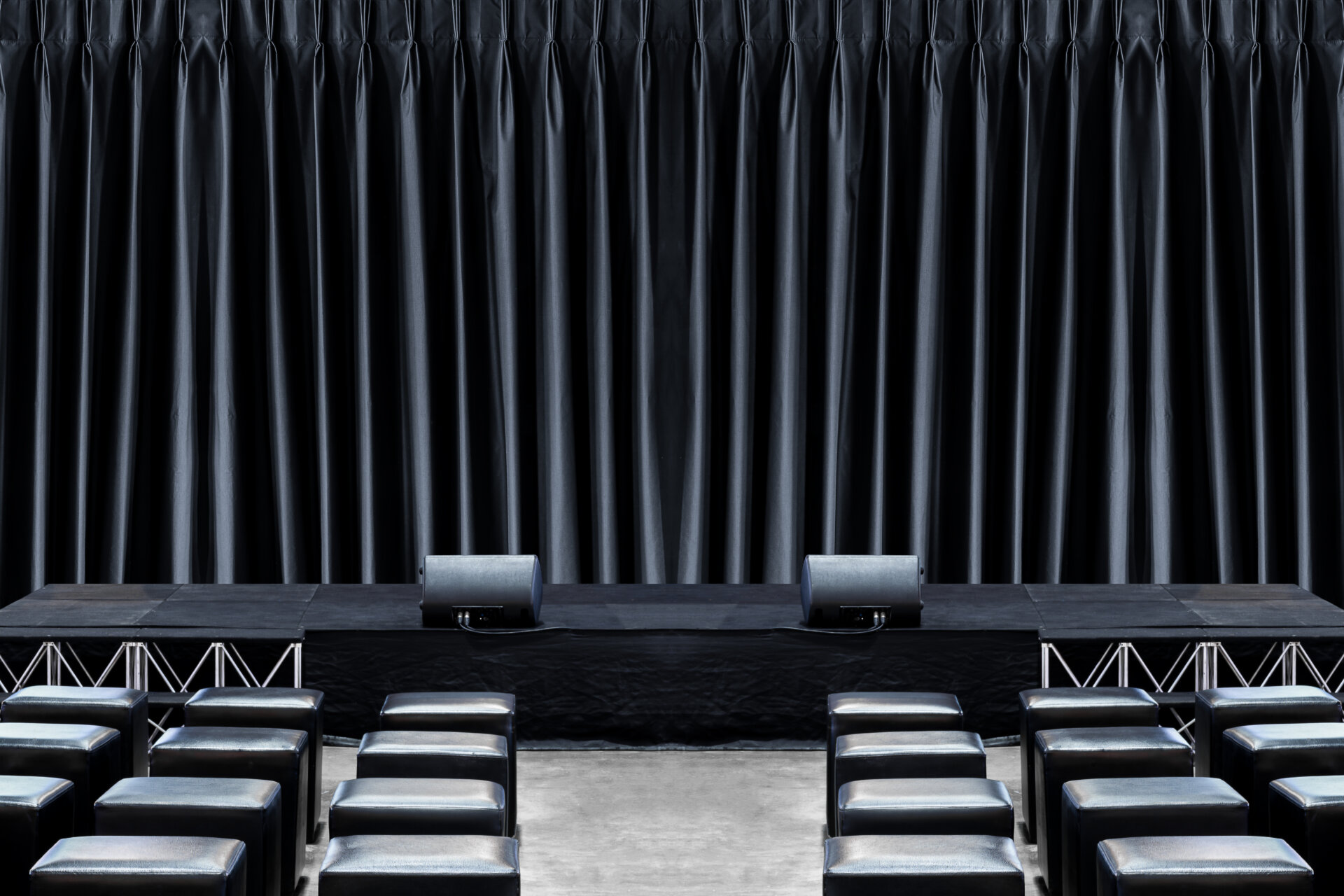
Stage skirting is a pleated or gathered fabric panel that clips to the top edge of a platform stage and hangs to just above the floor, covering the legs, cables and storage underneath. You size it by two numbers: the drop (roughly the deck height) and the total length of exposed edges in feet.
What Stage Skirting Does on Event Day
A portable stage is a set of flat decks sitting on legs or a frame. From the audience’s side, that frame is visible unless something covers it. Skirting is that cover.
In practice it handles a few jobs at once:
- It hides the legs, cross braces and leveling feet that hold the decks up.
- It creates hidden storage. Bands slide empty instrument cases under the deck, DJs run power strips and cable there, and planners stash spare centerpieces.
- It gives the stage a finished line in photos, which matters at weddings where the head table or first-dance spot sits on a riser.
- It ties the stage into the room’s color scheme, the same way tablecloths do for the tables.
A stage without skirting isn’t unsafe or wrong. It just reads as equipment rather than part of the room, and the eye goes straight to the gap underneath.
How Skirting Attaches to a Platform Deck
Most stage skirting has a strip of hook-and-loop fastener sewn along the top edge. That strip presses onto plastic or metal clips that grip the edge of the deck. The clips go on first, spaced close enough that the fabric doesn’t sag between them (about a foot apart is a common rule of thumb), then the skirt is pressed on in sections.
Some staging systems have a channel or rail built into the deck edge instead, and the skirt hangs from that. Either way, you shouldn’t need tape, staples or pins, and you shouldn’t use them on rented decks. Adhesive tape in particular leaves residue and tends to let go once the room warms up.
Sections join by overlapping a few inches at seams and corners. That overlap is why a skirt ordered to the exact edge length often comes up short.
Measuring the Drop and the Linear Feet
Two measurements cover nearly every skirting order.
Drop is how far the fabric hangs from the deck edge toward the floor. It should roughly match the deck height, with the hem sitting about half an inch to an inch off the floor so it doesn’t drag or get stepped on. Many portable stages come in common heights such as 16, 24 or 32 inches, and skirting is usually made to match those heights.
The drop is set by the deck height, and the deck height is set by the legs, so confirm the legs before you order the fabric.
The drop is set by the deck height, and the deck height is set by the legs, so confirm the legs before you order the fabric. A stage that gets swapped from 24-inch legs to 32-inch legs the week before the event will show 8 inches of hardware under a 24-inch skirt.
Linear feet is the total length of every edge the audience can see. Here’s a worked example for a 16 by 12 foot stage:
- Stage pushed against a back wall: front 16 feet plus two sides at 12 feet each equals 40 linear feet.
- Freestanding stage in the middle of a room: 16 + 16 + 12 + 12 equals 56 linear feet.
- Add overlap. If skirting comes in 10-foot sections, 40 feet works out to exactly 4 sections, but the corner and seam overlaps eat a few inches each, so plan on 5.
Stage dimensions not decided yet? Our guide to stage size for a band gives space per musician for common lineups. Lock that in first, since every skirting number flows from it.
Pleat Styles and the Look Each Gives
Skirting comes in a handful of standard constructions. The style changes how formal the stage looks more than the color does.
- Box pleat: flat, evenly spaced folds with crisp edges. Tailored and formal, common at galas, corporate events and weddings.
- Shirred or gathered: fabric bunched evenly along the top, giving soft vertical ripples. Looks fuller and a little softer.
- Accordion pleat: narrow, repeating folds. Neat and slightly more decorative than box pleat.
- Flat or tailored panel: no folds at all, often in stretch fabric pulled taut. Modern and minimal, good for product launches and stage riser displays.
Pleated and gathered skirts are sewn with the extra fabric already folded in, so they’re usually described by finished length. A 10-foot section covers 10 feet of edge, not 10 feet of flat cloth.
Choosing the Fabric
Fabric decides how the skirt hangs and how it handles the night.
Polyester is the workhorse. It holds a pleat, resists wrinkles in transport and comes in a wide range of colors that match standard event linens, which helps if you want the stage and the tables in the same shade.
Velour and velvet hang heavier and absorb light, so the stage edge almost disappears under performance lighting. That’s why theaters and bands lean toward black velour. Heavier fabric also moves less when people walk across the deck or a door opens nearby.
Stretch spandex gives the flat, fitted look. It needs a snug, even pull from corner to corner, so it works best on simple rectangular stages without lots of steps and jogs.
Sheer or shiny fabrics like organza and satin can work as an overlay on top of a solid skirt, but on their own they show the frame through the cloth.
Picking a Color That Holds Up
Black is the default for concerts, DJ setups and anything with stage lighting. It hides scuffs and shoe marks, and it doesn’t bounce light into camera lenses.
White and ivory suit weddings and daytime events, but they show every footprint from setup crew. If you go light, have the skirt attached after the band and AV team finish loading in, not before.
For a stage that’s meant to be the centerpiece of the decor, matching the skirt to the table linens or the backdrop pulls the room together. There’s more on that approach in our piece on using a stage as a focal point.
Stairs, Back Edges and the Backdrop
Steps leading onto the stage have open sides too. Skirting the stage but leaving the stair stringers bare is one of the more common oversights, and it shows in every photo of someone walking up to give a toast. Measure each exposed side of the steps and add it to your linear feet.
The back edge only needs skirting if guests can walk behind the stage or see it from another angle. Against a wall or a backdrop, you can skip it.
Skirting covers the bottom of the stage. Drapery behind the stage covers the wall, and that’s usually pipe and drape or wall panels and backdrops. Planning both together keeps the colors and fabric weights consistent from the floor up.
Fire Ratings and Venue Rules
Decorative fabric in a place where crowds gather is generally expected to be flame-resistant. A fire inspector handout on stage drapery safety points to NFPA 701 flame testing as the usual standard for drapes and similar textiles in assembly spaces like auditoriums, churches and halls, and stage skirting falls into that same family of fabrics.
New York City adds its own layer. This overview of NFPA 701 and NFPA 705 notes that the FDNY has specific requirements for stage curtains and fabrics. Rules can change, so confirm the current requirements with the FDNY directly. Many Brooklyn banquet halls and loft venues will also ask for a flame certificate for any fabric brought in, and some won’t let a vendor unload until the paperwork is on file. Ask the venue a week ahead so it isn’t a surprise at the loading dock.
Pro Tips for a Clean Skirt Line
- Attach the skirt last, after cables are run and cases are stored underneath. Pulling it off to reach something mid-setup leaves creases.
- Start at a back corner and work toward the front, so the final overlap ends up where nobody looks.
- Lawns call for the full inch of hem clearance. Damp grass wicks water into fabric that touches it, and wind lifts a skirt that has nowhere to settle, which happens a lot in open Long Island yards.
- Leave a small gap at the back for a power cable to exit, rather than running it under the front hem where it becomes a trip hazard.
- Steam pleated skirts the day before if they arrive folded, since wrinkles at the drop line are what people notice.
If the stage itself sits outdoors, the same leveling problems that affect dance floors apply. Our guide to putting a dance floor on grass covers shimming and settling, and an uneven deck makes the skirt hem wander up and down along the front.
Common Questions
Is stage skirting the same as a table skirt?
They’re built the same way, with a hook-and-loop top edge and clips, but stage skirting is made to longer drops for taller decks. A standard table skirt is cut for a table about 29 to 30 inches high, so it may be the wrong length for a 16-inch or 32-inch stage.
How do you attach stage skirting without damaging the stage?
Use skirting clips that grip the deck edge, then press the skirt’s hook-and-loop strip onto them. Avoid tape, staples and pins on rented decks.
Which skirting color looks most professional on a stage?
Black, in most settings. It hides scuffs and shadows and disappears under lighting. White or ivory reads well at weddings if the skirt goes on after load-in.
Do you need skirting on the back of a stage?
Only if guests can see it. A stage against a wall or backdrop usually needs skirting on the front and two sides.
How long should the skirting be?
The drop should be close to the deck height with the hem about half an inch to an inch off the floor. The total length is the sum of every visible edge, plus a few inches of overlap at each seam and corner.
One Last Measurement to Take
Before ordering anything, write down the stage dimensions, the final deck height and which edges face the audience. With those three facts, the skirting order takes a couple of minutes. If you’re still picking the stage, our staging and flooring rentals include a platform stage in several sizes, and it’s worth asking about skirting and steps in the same conversation so the heights match.