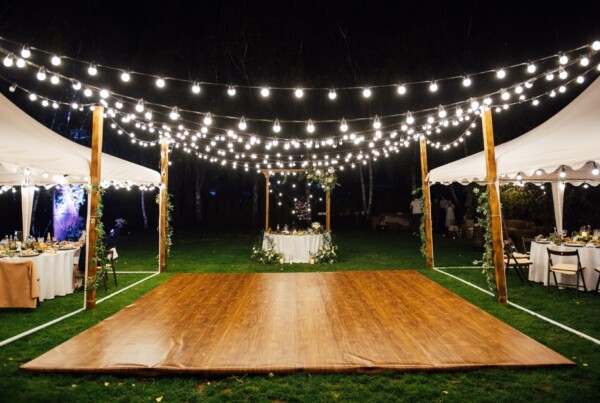



Yes, you can put a dance floor on grass, and plenty of backyard weddings do it every summer. The catch is that the panels can’t fix what’s underneath them: the lawn has to be firm, close to level and dry enough to hold weight, or the floor has to sit on a base that is. Get those things right and a lawn dance floor feels as solid as one in a banquet hall. Skip them and you get rocking panels, seams that catch heels, and a square of yellow grass that hangs around into fall.
Below is how I’d approach it after a lot of years building floors outdoors, from checking the yard a week out to deciding whether a raised platform makes more sense than panels on the ground.
Why Grass Gives a Dance Floor Trouble
Most rental dance floors are made of interlocking panels, commonly around 3 or 4 feet square, that lock together along their edges. On a patio or a gym floor every panel sits flat, so the joints stay tight. Grass behaves differently. It compresses under weight, and it doesn’t compress evenly. A spot over an old tree root holds firm, while the patch near the downspout gives a little more with every step.
Here’s what that turns into once people start dancing:
- Soft spots sink when a crowd jumps through a fast song, and the panel above tilts just enough to open a seam.
- Most yards are graded to drain water away from the house, which is great for the basement and bad for a floor that wants to be flat.
- Dew, sprinklers and rain soak in from below, so panels get slick on top and some floor finishes can warp or stain.
- Sprinkler heads, drain covers, rocks and mole tunnels create high and low points the panels rock over.
None of this makes grass a bad idea. It just means the real work happens before the floor arrives.
Check the Lawn the Week Before
A short walk around the yard a week or so ahead tells you almost everything you need to know. This is the routine I’d suggest to anyone hosting on their own lawn:
- Pick the flattest, firmest patch. Walk the yard slowly in flat shoes. Anywhere that feels spongy under you will feel worse with a crowd on it. Stay out of low spots where puddles form after rain.
- Check the slope in both directions. Lay a long straight board on the grass with a carpenter’s level on top, then turn it 90 degrees and check again. If the bubble drifts noticeably, plan on leveling and tell your rental company roughly how far off it is.
- Flag sprinkler heads and drains. Mark every one inside or near the footprint. A pop-up head under a panel is a classic cause of one wobbly corner.
- Turn off the irrigation a few days early. Dry ground is firmer ground. If the system runs on a timer, make sure it stays off the night of the party too.
- Mow a day or two before. Short grass lets the panels sit lower and flatter. Rake up the clippings so they don’t get trapped under the floor and turn slimy.
- Measure the route in. Check gate widths, steps and any narrow side yard between the driveway and the lawn. Panels and stage pieces get wheeled in, and a tight gate changes how the crew plans the delivery.
A couple of photos of the area with a tape measure stretched across it will save a lot of back and forth with your rental company. If you haven’t settled on a footprint yet, our breakdown of what size dance floor you need for 100 guests walks through the sizing.
What Goes Between the Grass and the Panels
The setups run from simple to fully built, and the right one depends on your lawn, the size of the party and how long the floor stays down.
Panels straight on the lawn
This can work for a small, short gathering on a lawn that’s firm, flat and dry, like a kid’s birthday or a few hours of dancing at a graduation party. The bigger the crowd and the longer the night, the more likely you’ll feel the ground shifting under you by the end.
Panels on a subfloor
A layer of plywood sheets or ground protection mats goes down first, and the dance floor locks together on top. The subfloor spreads each dancer’s weight over a wider area, so no single soft spot can sink on its own. Many outdoor setups also add a plastic sheet on the grass to keep ground moisture away from the panels. For a wedding or a long party on a lawn, this is the approach I’d want. Ask your rental company whether they bring the subfloor or expect you to arrange it.
A raised platform
Stage decks on legs sit above the grass entirely, and adjustable legs can be set at different heights to take the slope out of the equation. It’s more equipment, and I’ll weigh it up properly further down.
Heads-up
Don’t level a floor by jamming whatever’s in the garage under the low corners. Scrap wood, folded tarps and pavers shift once people dance, and a shim that slides out mid-song leaves a panel corner hanging in the air. Leveling should use solid, flat material across the entire low side, or a platform with legs made to adjust.
Leveling a Floor on a Sloped Yard
Suburban lawns almost always tilt a little, since builders grade them on purpose to shed rainwater away from the foundation. Panels set straight onto that grade will follow it. A slight tilt, guests barely notice. Anything more and dancers drift downhill, any chairs on the floor lean, and the joints on the low side take extra stress all night.
The floor will only ever be as flat as whatever is holding it up. For a mild slope, that usually means a subfloor built up evenly on the low side so the top surface comes out flat. Please don’t dig out the high side of a lawn you’ll be living with afterward, and never do it in a yard you don’t own.
For a steeper grade, a platform stage is the cleaner fix. The legs on the downhill side extend further than the uphill ones, and the deck ends up level. On soft ground, put a board or pad under each leg so the weight spreads out and the feet don’t slowly sink into the lawn. Bill Jax staging, which is built around adjustable legs, handles uneven ground well, and our staging and flooring options include both platform and Bill Jax setups.
Once the surface sits more than a step off the ground, plan for steps at every entry point and, depending on height, railings along any open edge. Ask about this early, since it changes the layout around the floor.
Protecting the Lawn Under the Floor
Grass under a dance floor gets no sun and very little air. One evening rarely does lasting harm. A floor left down for several days, especially in summer heat, can leave a pale or yellowed patch that takes a while to come back. The practical answer is to schedule delivery as close to the event as your timeline allows and pickup soon after.
The delivery itself can be harder on a lawn than the party. Loaded dollies rolling across soggy grass leave ruts, and the same path gets used again at pickup. If it rained the day before, lay plywood or mats along the route from the driveway or gate to the floor area, and keep cars off the lawn entirely.
The floor will only ever be as flat as whatever is holding it up.
After pickup, give the grass a good watering and leave it alone for a few days. A light rake helps flattened blades stand back up.
Edges, Heels and a Rainy Forecast
The edge of the floor is where most trips happen. Ask for beveled edge trim on a ground-level floor so the step from grass to panel is a gentle ramp rather than a lip. On a raised platform, the drop at the edge is easy to miss after dark, so make sure your lighting plan reaches the perimeter and keep table legs and chair legs off the edge entirely.
Heels are the other thing people forget. Guests in stilettos sink into a lawn all evening, and the dance floor is the one place they won’t. Setting the floor close to the tables and the bar keeps the walk across the grass short, which your guests will appreciate around the third hour.
An uncovered floor gets slick in rain and even heavy dew. If you’re bringing in a tent from a tent company, ask them early whether the floor goes under it and plan the floor size around the pole positions. Either way, keep a few towels and a squeegee nearby so someone can dry the surface between showers.
Parks, Permits and Backyard Rules
In your own backyard on Staten Island or in the suburbs, a dance floor usually doesn’t need a permit on its own. Homeowners associations, some villages and certain towns do have rules about large gatherings, noise or structures, so a quick check with your HOA or municipal office is worth it, especially if a raised platform is involved.
Public parks are a different story. NYC Parks treats things like stages as temporary structures that need a special event permit from NYC Parks, and applications generally have to go in at least 21 days before the event. If you’re dreaming of dancing on a lawn in a Manhattan park, confirm with the agency exactly what your floor setup needs before you book anything, and leave yourself more than the minimum lead time.
A Raised Platform on Grass, Weighed Up
For a lot of lawn events, the real decision is between a floor on a subfloor and a full platform. A platform is the more reliable surface on uneven ground, but it isn’t automatically the right call. Here’s how it stacks up on grass specifically.
Pros
- Can be leveled over a slope that panels on the ground couldn’t handle
- The dancing surface never touches wet grass
- Less settling during the night because the load rests on the legs and their pads
- Doubles as a spot for toasts, a band or a DJ setup
- Gives the dance area a clear, defined edge
Cons
- Needs steps, and railings once it’s high enough
- More pieces to bring through gates and side yards, and a longer setup
- Leg feet need pads or boards so they don’t sink on soft ground
- Typically adds cost over a floor alone
If the yard is flat and firm, a subfloor and panels are usually plenty. If you’re working with a real slope, or you want the band and the dancing in one raised spot, the platform earns its keep. Our post on stage rentals for backyard weddings goes further into staging for home receptions.
What to Ask Before You Book
- Do you lay a subfloor on grass, or should I plan on providing one?
- How much slope can your floor handle before you’d recommend a platform instead?
- Can the floor be sized to fit the flat part of my yard exactly?
- How wide does the access path need to be for the panels and stage pieces?
- How far ahead of the event do you set up, and how soon after do you pick up?
- At the height my yard needs, will the platform require steps and railings?
- What happens if the lawn is waterlogged on delivery day?
FAQs
Can you put a dance floor directly on grass?
You can on a firm, flat, dry lawn for a small or short event. For weddings, bigger crowds or uneven ground, a plywood or mat subfloor underneath keeps the panels from shifting and the seams from opening.
How do you level a dance floor on uneven ground?
For a mild slope, build the subfloor up evenly on the low side so the top surface comes out flat. For a steeper grade, use a platform with adjustable legs and put pads under the feet so they don’t sink. Avoid loose shims, which slide out once people dance.
Will a dance floor kill my grass?
One evening usually won’t. Several days under a floor, especially in hot weather, can leave a yellowed patch that needs time to recover. Keep the floor down for as short a window as possible and water the area after pickup.
Is plywood alone good enough to dance on outside?
Plywood works well as a subfloor but makes a rough dance surface. It can splinter, it gets slippery when wet, and the sheet edges catch heels. Use it under a proper dance floor rather than as the floor itself.
Do you need a permit for a dance floor in a NYC park?
Generally, yes. NYC Parks requires a special event permit for temporary structures such as stages, with applications due at least 21 days ahead. Confirm the details for your specific setup directly with NYC Parks.
Start With a Walk Around the Yard
Nearly every lawn can carry a dance floor once you know where it’s soft, where it slopes and how the crew gets in. Do that walk, snap a few photos with the tape measure out, and the rest of the planning gets a lot simpler. If you’d like a second set of eyes on your yard and a floor or stage sized to it, send us your photos and event details and we’ll help you figure out what your lawn needs underneath the dancing.