


The mistake I see most often goes like this. Someone falls for a green velvet tablecloth in a bright daytime photo, books it, and then watches it turn almost black under the candles at their 8 p.m. dinner. Choose your tablecloth by the light your room will have when guests sit down, then match it to the colors already in the space. Dim, warm rooms usually need a green one step brighter than you’d guess, and the deepest hunter greens look their best in daylight or well-lit rooms.
That’s honestly most of the secret. Everything below is about getting the details right, from the shade to the drop length, so your tables look the way you pictured them.
Key takeaways
- Velvet looks darker and shifts color more than flat linens, so judge any swatch in the venue’s real light.
- Hunter and forest greens suit bright rooms and daytime events. Emerald and moss hold up better under candlelight.
- Warm bulbs push green toward olive, and cool LEDs push it toward teal.
- For a floor-length look, add about 60 inches to the tabletop measurement. On a standard banquet round of 60 inches, that means ordering a 120-inch cloth.
Velvet Plays Tricks With Color
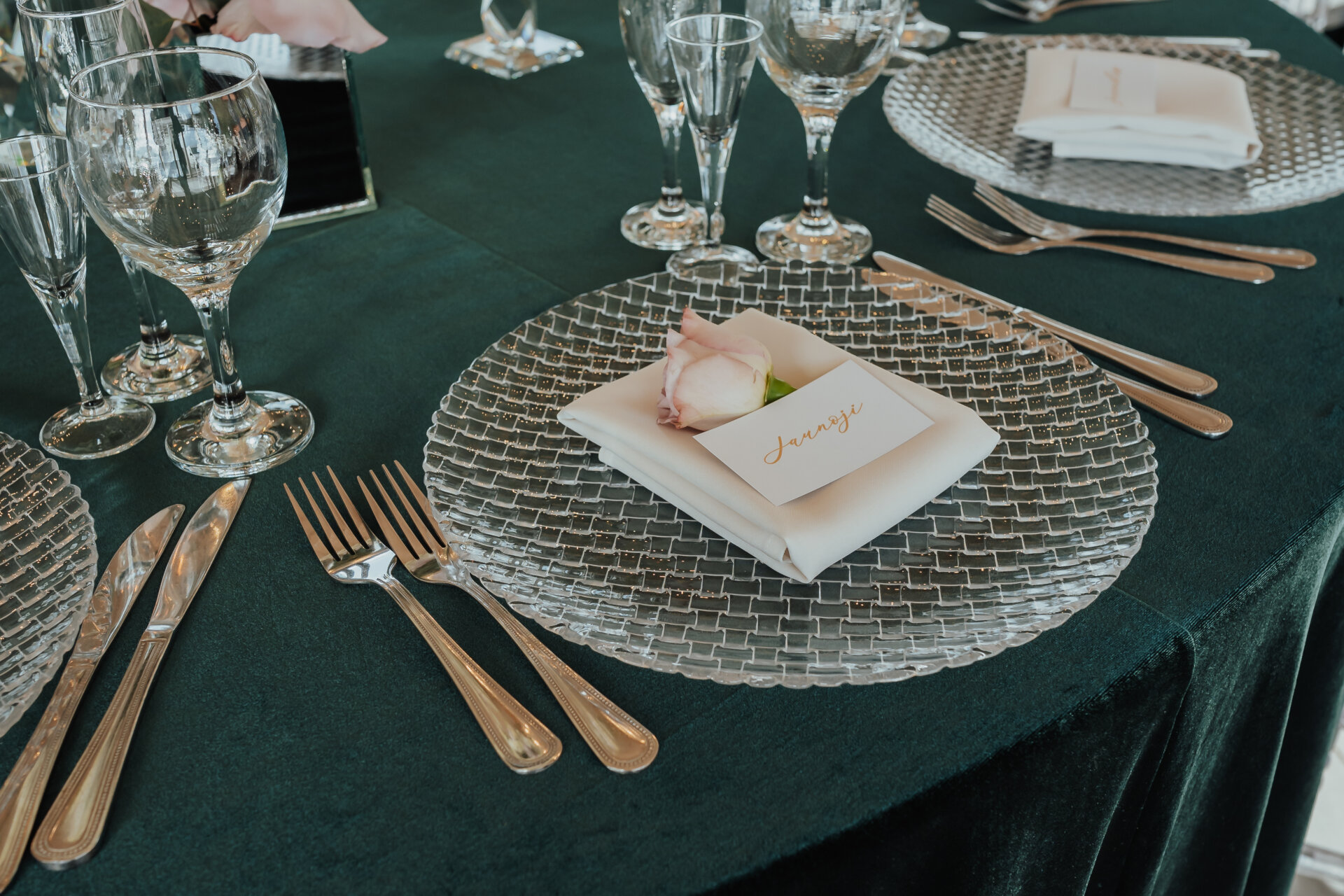
Velvet has a pile, a dense layer of short fibers standing up from the base fabric. Those fibers catch light on their tips and swallow it in between, so the same cloth looks lighter on the flat tabletop and darker where it falls over the edge.
There’s also a nap. Brush velvet one way and it looks soft and a little pale. Brush it the other way and it goes deep and shadowy. On a round table the fabric drapes in every direction at once, which is why you’ll often see two or three tones of green on a single cloth. That’s part of the charm, but it means the color on your screen is only a rough guess.
A flat polyester tablecloth barely does any of this. Velvet does it all evening, and the effect gets stronger as the room gets darker. In a dim room, the darkest green velvet can read as black from ten feet away. Crushed velvet, with its random texture, hides creases and the odd elbow mark better, while smooth velvet has more sheen and shows every brush stroke.
In a dim room, the darkest green velvet can read as black from ten feet away.
The Greens You’ll See and Where Each One Fits
Shade names vary from one linen supplier to the next, so treat these as families rather than exact colors.
Hunter green and other dark green velvet
Hunter green has a touch of blue and gray in it. It’s the classic choice for winter weddings, holiday parties and milestone birthdays with a gold and ivory theme. A hunter green velvet tablecloth looks rich and steady in a room with white walls, big windows or plenty of overhead light. Put it in a candlelit space with dark floors and it can lose its color entirely, so save it for rooms that can show it off.
Emerald
Emerald is the jewel tone of the group, brighter and more saturated. Because it starts out lighter, it keeps reading as green even under a few votives, which makes it a smart pick for evening receptions. Under cool white LEDs it can drift toward teal, so check it in the actual room if your venue uses those.
Moss green velvet
Moss leans yellow and olive. It’s earthy and relaxed, and it loves natural wood, rust, cream and dried flowers. A moss green velvet tablecloth under warm bulbs turns golden olive, which can look lovely in a rustic room. If the walls are already yellow or beige, though, it can start to look muddy.
Sage and lighter greens
Pale greens read soft and dusty in velvet, almost pastel. They suit spring showers, brunches and daytime garden parties. Lighter velvet also shows wine drips and wax more clearly, so they’re happiest at events with good daylight and a lighter menu.
Reading the Light in Your Venue
Before you pick a shade, figure out what kind of light your guests will actually be sitting in. Here’s how the common setups change things:
- Candlelight and warm incandescent bulbs, like the Edison strings you’ll find in a lot of Williamsburg lofts, shift everything warm. Blue-leaning greens dull a bit, yellow-leaning greens go golden, and very dark shades lose detail. Go a little brighter than your first instinct.
- Cool white LED or fluorescent light, common in hotel ballrooms and catering halls, makes green look crisp and slightly cooler.
- Daylight from big windows shows the truest color, and also every crease and bit of lint.
- Colored uplighting from the venue or your DJ can be a wild card. Amber tends to flatter green, while blue or purple washes can turn it grayish. Ask what color they’re planning.
The best test is simple. Visit the venue at the same hour as your event and bring a green velvet swatch or even a green velvet pillow from home. Trust your eyes over your phone, because phone cameras auto-correct color and will make dim green look brighter than it is.
Building a Color Scheme Around Green Tables
Green velvet is a strong color, and a room full of it can feel heavy. Interior designers often suggest anchoring with neutral tablecloths and saving deeper shades for special occasions, and that thinking works well at events too. One approach is to put velvet on the tables that matter most (the sweetheart or head table, the cake table, a dessert spread) and dress guest tables in ivory or white. The other is to go all in on green and lighten things up with ivory napkins and pale florals.
A few pairings that tend to work:
- Gold and ivory, the classic combination, especially with hunter green or emerald
- Blush and cream for a softer, romantic feel
- Copper, rust and natural wood with moss green
- Burgundy and gold for a holiday party
- Black and gold for a moody evening, as long as the room has enough light to keep the green from disappearing
Chairs make a big difference. Gold ballroom chairs look warm and formal against deep green, clear chiavari chairs keep the focus on the velvet, and wood cross back chairs suit moss and olive tones. Green can anchor a whole scheme on its own, and our piece on choosing the right color palette shows how to build out the supporting colors from that one shade.
One more thing: if the room will also have a velvet backdrop, either match the green closely or choose a clear contrast like ivory. Two slightly different greens next to each other tend to look like a mistake.
How to Size Round and Long Green Velvet Tablecloths
Most banquet tables are about 30 inches tall. For a floor-length cloth, you need 30 inches of drop on every side, so add 60 inches to the tabletop’s diameter or to each dimension.
- 48-inch round (seats about 6): 108-inch round cloth
- 60-inch round (seats about 8): 120-inch round cloth
- 72-inch round (seats about 10): 132-inch round cloth
For round green velvet tablecloths, floor length is the usual choice because velvet is heavy and hangs in deep, straight folds. If you’d rather stop at lap length, about 15 inches of drop, add 30 inches instead, so a 90-inch cloth suits a 60-inch round. Avoid going longer than floor length with velvet, since the thick fabric bunches at the floor and catches chair legs.
For an 8-foot rectangle (96 by 30 inches), a 90 by 156-inch cloth reaches the floor on all sides, since 30 plus 60 is 90 and 96 plus 60 is 156. Our article on tablecloths for an 8-foot rectangle table covers the other drop options. You can also browse our linens to see what’s available.
Velvet Outdoors and Other Practical Details
Velvet absorbs heat, so it gets warm to the touch in summer sun and soaks up dew and rain spots. It’s a better fit for evening events, fall and winter parties, or tables under cover. A Brooklyn backyard behind a brownstone at dusk in October? Lovely. A July noon picnic? Probably not.
If your plans move into a city park and include a tent, a generator or amplified sound, NYC Parks says a special event permit is required and recommends applying at least 21 days ahead. Rules change, so confirm the details directly with the agency.
Indoors, the main practical issue is creasing. Folded velvet can show fold lines, so give the cloths a little time on the tables before guests arrive, and ask how the linens will come to you.
What to Ask Before You Book
- Which shades of green velvet are available for my date, and can I see a swatch or a photo taken in natural light?
- Is it crushed velvet or smooth?
- Do you have the exact sizes for my table diameters and lengths?
- How are the linens delivered, and should I expect fold lines?
- What’s the policy on candle wax or wine stains?
- Do you carry napkins or runners that coordinate with the green?
- Does my venue need a certificate of insurance before delivery? Many Brooklyn venues and apartment buildings do, so ask the venue early.
Picking Your Green in Six Steps
- See the room at party time. Visit when the light matches your event hour, or ask the venue for evening photos.
- Note what’s already there. Wall color, floors, chairs and any fixed decor will sit right next to your tables.
- Choose a shade family. Bright room, go deep. Dim or candlelit room, go brighter, like emerald or moss.
- Test a swatch in that light. Look at it flat and draped over an edge, since velvet changes with the angle.
- Measure and pick your drop. Add 60 inches for floor length or 30 for lap length.
- Decide which tables get velvet. All of them, or just the head table and dessert table, then confirm your counts.
Questions We Hear a Lot
What colors go with a dark green velvet tablecloth?
Gold, ivory and cream are the easiest matches. Blush softens it, burgundy makes it feel festive, and copper works well if the green leans olive. Keep at least one light color on the table so the green doesn’t swallow everything.
Is hunter green velvet a good choice for a wedding?
Yes, especially for fall and winter weddings or formal evening receptions. Just make sure the room has enough light, or pair it with plenty of ivory and gold so it reads as green rather than black.
What size round green velvet tablecloth fits a 60-inch table?
A 120-inch round reaches the floor on a standard 30-inch-tall table. For lap length, a 90-inch round gives about 15 inches of drop.
Is moss green or hunter green better for a fall event?
Both work. Moss feels more rustic and pairs with wood and rust tones, while hunter feels more formal and pairs with gold. Let your venue’s lighting break the tie.
Trust Your Eyes in the Real Room
Green velvet is one of the warmest, most inviting looks you can put on a table, and it’s not hard to get right once you stop judging it from a screen. See the room, test the shade, measure your tables, and you’ll be in great shape. If you’d like help matching a green to your venue or sizing your cloths, send us your table list and a few photos.