


You’re trying to decide whether your tables need a full tablecloth, a table runner, or both. Use a tablecloth whenever the tabletop isn’t meant to be seen, which covers folding tables, banquet tables and rounds. Use a runner alone only when the table looks good on its own, like rustic wood. Layer a runner over a cloth when you want full coverage plus a strip of color or texture.
Below, that rule is broken down by table type, with sizing numbers for each linen and a sample count for a real event, so you can order the right pieces the first time.
When Should You Use a Table Runner or a Tablecloth?
Start with what’s under the linen. Color, fabric and budget come second, because most of the decision is made once you know the table.
- Plastic folding and laminate banquet tables: tablecloth, ideally floor-length so the legs and frame disappear.
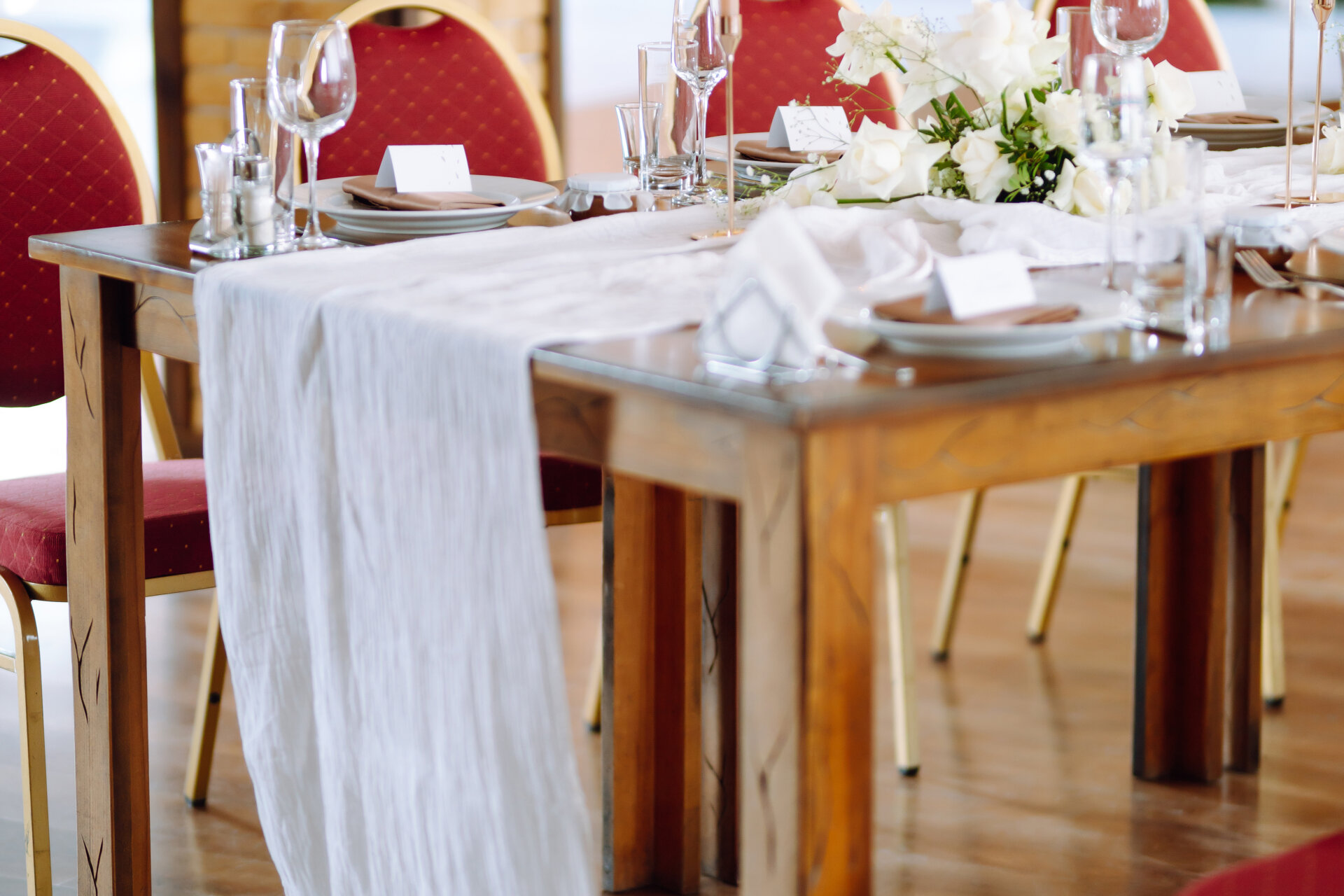
- Rustic wood or farm tables: runner alone, or left bare.
- Round tables: tablecloth. A runner laid across a round crosses the center and drops off only two points of the edge, which usually looks like an afterthought.
- Highboy cocktail tables: tablecloth, often cinched with a sash at the middle. There’s no long surface for a runner to work with.
- Buffet, gift and dessert tables: tablecloth, since the sides and whatever is stored underneath face guests.
If your venue supplies its own tables, ask what they’re made of and request a photo. A “wood table” can mean finished walnut or a stained plywood top with chipped edges, and those call for different linens.
What a Full Tablecloth Handles That a Runner Can’t
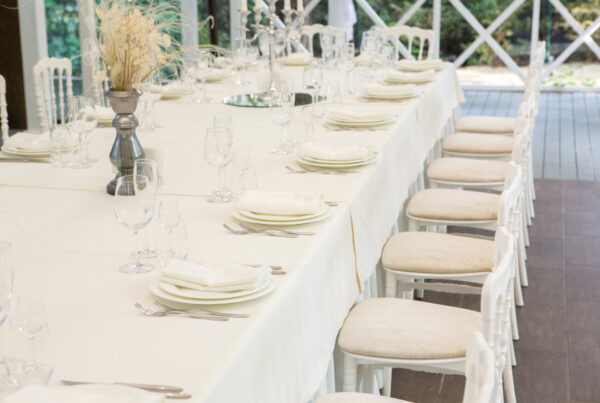
A tablecloth covers the whole top and, depending on the drop, some or all of the sides. That hides wear, folding hardware and boxes stored under a buffet. It also gives every guest the same surface, so place settings read as consistent from one end of the room to the other.
There’s an acoustic reason, too. Plates, glasses and flatware sound louder on a bare table, and a full cloth softens that clatter, a point Home Stratosphere makes in its comparison. In a hard-surfaced room, like a Brooklyn loft with concrete floors and brick walls, that difference adds up across 15 tables of dinner service.
The tradeoff is that the table itself vanishes. If you’ve chosen rustic wood tables for the grain, a floor-length cloth defeats the purpose. Fabric matters as well; our breakdown of polyester and linen tablecloths covers wrinkling, drape and how each handles stains.
Using a Runner on Its Own
A runner-only table is a deliberate look. It works when the wood is the decor and the runner is simply the center stripe that holds candles, flowers or shared platters.
Pros
- Shows off the grain of wood farm and rustic tables
- Less fabric per table, so less steaming and fewer wrinkles to fight
- Creates a clear center line for centerpieces on long family-style rows
- Changes the color story without replacing a full cloth
Cons
- Leaves edges and legs exposed, so the table has to look good up close
- Dishes are louder on a hard top
- Spills land on the bare surface
- Lightweight fabric lifts in wind once centerpieces come off
- Doesn’t suit rounds or highboys
That wind point matters for backyard parties on Long Island or in New Jersey. A runner weighs very little and will flip at the first gust once the table is cleared at the end of the night. Table clips at each end, or heavier items set directly on the runner, keep it down.
Floor-length tablecloths catch wind as well, acting almost like a sail on an open lawn. For outdoor events, many hosts choose a shorter drop or clip the corners.
Table Runner Length vs Tablecloth Drop
Both are sized from the table, but they measure different things. A tablecloth’s drop is measured on every side. A runner only overhangs the two short ends.
Tablecloth sizing
Standard rental tables stand about 30 inches tall. The formula is the table dimension plus twice the drop.
- Floor-length on a 6-foot table (30 x 72 inches): 30 + 60 = 90 wide, 72 + 60 = 132 long, so 90 x 132 inches.
- Floor-length on an 8-foot table (30 x 96 inches): 90 x 156 inches.
- Lap length (about a 15-inch drop) on an 8-foot table: 30 + 30 = 60 wide, 96 + 30 = 126 long, so 60 x 126 inches.
- Floor-length on a 60-inch round: 60 + 60 = a 120-inch round.
For more detail on long tables, see our guide on tablecloth size for an 8-foot table.
Runner sizing
Center the runner lengthwise and let it hang roughly 6 to 10 inches past each end, a common guideline for rental tables. Some stylists go to 15 inches, and one wedding styling guide suggests a width of about one third of the table.
- 8-foot table, 6-inch overhang: 96 + 12 = 108-inch runner.
- 8-foot table, 10-inch overhang: 96 + 20 = 116-inch runner.
- 6-foot table, 8-inch overhang: 72 + 16 = 88-inch runner.
- Width on a 30-inch-wide table: 30 / 3 = 10 inches, so aim for about 10 to 12 inches.
Why is a runner’s overhang so much shorter than a floor-length cloth’s 30-inch drop? The ends of a banquet row usually have seats. A runner hanging 30 inches would land in the lap of whoever sits there, while 6 to 15 inches clears their knees.
A Worked Example for a 120-Guest Reception
Say you have 120 guests at 8-foot tables, and each table seats 10: four guests along each long side and a single guest at each short end. Divide 120 by 10 and you get 12 guest tables. You also need a cake table, a gift table and a head table, which brings the total to 15.
- Layered look on standard banquet tables: 15 floor-length cloths (90 x 156 inches) plus 12 runners (about 108 x 12 inches) on the guest tables only. That’s 27 pieces.
- Runner-only look on rustic wood guest tables: 12 runners, plus 3 cloths for the support tables, which are usually standard folding tables. That’s 15 pieces.
Switching the guest tables to wood drops your cloth count from 15 to 3. Add a spare of each type if spills are likely. Our guide on how many tablecloths you need covers the extra tables people forget.
The Three Options Side by Side
| Factor | Tablecloth | Runner only | Runner over tablecloth |
|---|---|---|---|
| Hides the table | Yes, fully at floor length | No | Yes |
| Best table types | Folding, banquet, round, highboy | Rustic wood, finished farm tables | Long banquet rows, head tables |
| Dish noise | Softened | Louder on a hard top | Softened |
| Outdoors in wind | Floor length catches gusts | Lifts easily when unweighted | Cloth catches gusts, runner needs weight |
| Spill coverage | Full surface | Center strip only | Full surface |
| Pieces per table | 1 | 1 | 2 |
Weddings, Trade Shows and Dinner Parties
Table Runner or Tablecloth for a Wedding Reception
Long family-style rows are where runners earn their keep, either over wood or layered on a cloth. Receptions on rounds almost always use tablecloths, with color carried by the centerpieces, napkins or chairs instead. To decide which shade goes on the base and which goes on the accent, the steps in our article on choosing an event color palette apply directly to linens.
Tablecloth or Table Runner for a Trade Show
Booth tables are often 6 feet long, and a floor-length cloth hides boxes, bags and cords stored underneath. A runner at a trade show is usually draped front to back so it hangs down the front edge and shows a brand color or logo. Most exhibitors use both. Some venues and shows have rules about flame-resistant fabric for booth draping, and requirements vary, so read the exhibitor manual and confirm with show management or the venue (and, if they point you there, the local fire authority) before you order.
Tablecloth, Table Runner or Placemats
Placemats mark each individual setting and suit small dinners on a good-looking table. They don’t hide anything, they don’t quiet the space between settings, and a 10-seat table needs 10 of them. They’re also not part of what we rent, so you’d source them separately.
Layering Both Without Clutter
A runner shouldn’t be identical to the tablecloth underneath, a point the same styling guide stresses. Contrast in color, texture or both: a matte ivory cloth with a deeper-toned runner, or a smooth base with a textured strip on top.
Set centerpieces directly on the runner so it reads as the anchor for the table, not a ribbon floating between place settings. On a 30-inch table, a 10 to 12-inch runner leaves about 9 to 10 inches on each side, enough room for plates to sit near the edge without crowding the flowers. You can browse base cloths and colors on our linens page.
Send Over Your Table List
The fastest way to get linens right is to start with a list: table shapes, sizes, how many of each, and whether any of them are outdoors. From there the cloth and runner math takes a few minutes. B&B is a family-owned Brooklyn rental company with more than 25 years of experience dressing event tables, so send what you’re working with and we’ll help match linens to each table.