


Short answer: choose a sweetheart table if your wedding party is big, your family tree has a few complicated branches, or you want some quiet time with your new spouse. Choose a head table if your wedding party is small and you want your closest people beside you at dinner. Neither is more correct. The decision usually comes down to headcount, wall space and family politics, roughly in that order.
Below is the longer version: what each setup really is, the math on how long a head table gets, the in-between options most couples don’t hear about, and what each one takes to build on the day.
Key takeaways
- A sweetheart table seats only the two of you and fits in almost any room.
- A head table seats the couple and wedding party in a row facing the guests, at about 2 feet of table edge per person.
- Once 12 or more people sit at the head table, its length (and the wall behind it) becomes the real problem.
- Divorced parents or tense family situations are a strong argument for a sweetheart table.
- Hybrid setups exist, so you don’t have to pick an extreme.
Two Very Different Ways to Seat the Couple
A sweetheart table is a table for two. It’s usually a small round, somewhere around 36 to 48 inches across, or a 4-foot rectangle, set a little apart from the guest tables. Most couples put it front and center, often in front of a backdrop or at the edge of the dance floor, with both chairs facing the room.
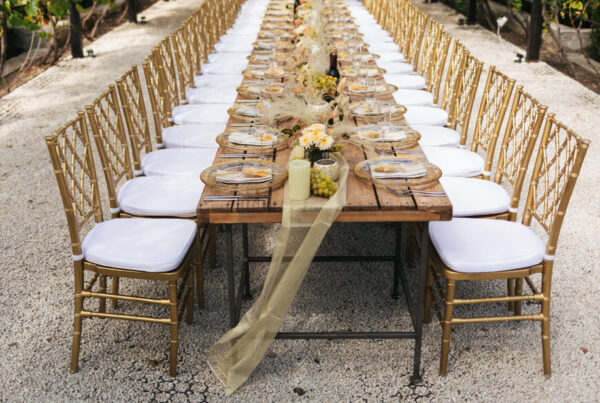
A head table is a straight run of rectangular tables with everyone seated on one side, facing the guests. The couple sits in the middle, the maid of honor and best man flank them, and the rest of the wedding party fans out toward the ends. Some couples add partners, and a few add parents. A variation seats people on both sides of a long table, family style, which some planners call a king’s table. More on that later.
How the Two Compare
| Sweetheart table | Head table | |
|---|---|---|
| Who sits there | The couple only | Couple plus wedding party, sometimes partners or parents |
| Typical table | One small round or a 4-foot rectangle | Several 6-foot or 8-foot rectangles in a row |
| Space needed | A small footprint almost anywhere | Roughly 2 feet of wall per person, plus room behind the chairs |
| Works best with | Large wedding parties, or none at all | Small to mid-size wedding parties |
| Wedding party experience | They sit with their dates and mingle | They sit with you, on display |
| Family politics | Sidesteps seating order entirely | Seating order can become a statement |
| Photos | Clean shots of the two of you | Group shots, including whoever is mid-bite |
Six Factors That Decide It
Headcount sets the length of a head table
This is the one that settles most debates. Each person at a head table needs about 24 inches of table edge to eat without bumping elbows. An 8-foot banquet table gives you 96 inches along one side, so it seats four people comfortably when everyone faces the room.
Take a wedding party of five bridesmaids and five groomsmen plus the two of you. That’s 12 people times 24 inches, or 288 inches, which is 24 feet. Three 8-foot tables in a row. Very doable in most reception rooms.
Now add partners for all ten attendants. You’re at 22 people, which is 528 inches, or 44 feet. Six 8-foot tables (48 feet total) seats everyone with about 26 inches each. That’s the sweetheart table versus head table question in its purest form: one option fits on a rug, the other needs most of a ballroom wall. The Carriage House of Yorktown points out that a big wedding party may simply not fit at a head table, and suggests a sweetheart table or splitting the party across several tables instead.
Partners and dates need seats too
With a classic one-sided head table, partners either join the row (making it longer) or sit at a guest table without the person they came with. The groomsman’s girlfriend who knows nobody at table 14 will remember your wedding, just not fondly.
A sweetheart table quietly solves this. Your attendants sit with their dates at regular tables, and nobody spends dinner staring across the room at their plus-one.
The room has to have the wall for it
Head tables usually go against a wall or in front of windows so nobody sits with their back to the room. Count the clear wall: no doors, columns, bars or kitchen entrances. You also need a few feet behind the chairs so people can push back and servers can get through.
Plenty of reception spaces around NYC, Long Island and New Jersey, especially lofts, restaurant buyouts and older catering halls, don’t have 30 or 40 uninterrupted feet to give. A sweetheart table, on the other hand, slides into almost any spot with a decent view of the room.
Family dynamics often make the call
A head table forces a seating order, and seating order sends messages. Divorced parents, stepparents, a sibling who isn’t in the wedding party, a friend who expected to be: all of that gets more visible when the most important people at the wedding sit in a literal ranked row. The Carriage House guide also flags family sensitivities as a factor in this choice, and in practice it’s often the deciding one.
With a sweetheart table, each set of parents can host their own table full of their own people, close to you and nowhere near each other if needed. It’s diplomacy by furniture.
Alone time versus time with your people
Inside Weddings lays out the trade-off well: a sweetheart table gives the couple some private time and frees the wedding party to mingle, while a head table keeps guests feeling closer to the couple. Both are true.
Honest caveat: you won’t get much alone time at a sweetheart table anyway, because guests will line up to say hello the moment you sit down. And some couples find it a little lonely, like eating dinner in a restaurant’s front window. If your favorite part of any party is the running commentary from your best friend, sit next to your best friend.
Photos and sightlines come out differently
A sweetheart table photographs cleanly: two people, one table, one backdrop. A head table photographs as a group, which is lovely during toasts and less lovely when your photographer catches the best man with a mouthful of short rib.
Sightlines matter too. At a large wedding, guests in the back may only see the tops of heads at a long head table. Putting either setup on a low riser helps everyone see you, especially during toasts.
Setups Between the Two Extremes
Plenty of couples land somewhere in the middle. A few options that work well:
- A sweetheart table with the wedding party and their dates at the two closest guest tables, so your people are a few steps away.
- A short head table for just four: the couple, the maid of honor and the best man, on a single 8-foot table.
- A two-sided king’s table, with attendants and partners facing each other and the couple at the center. Conversation is better, but half the table has its back to the guests.
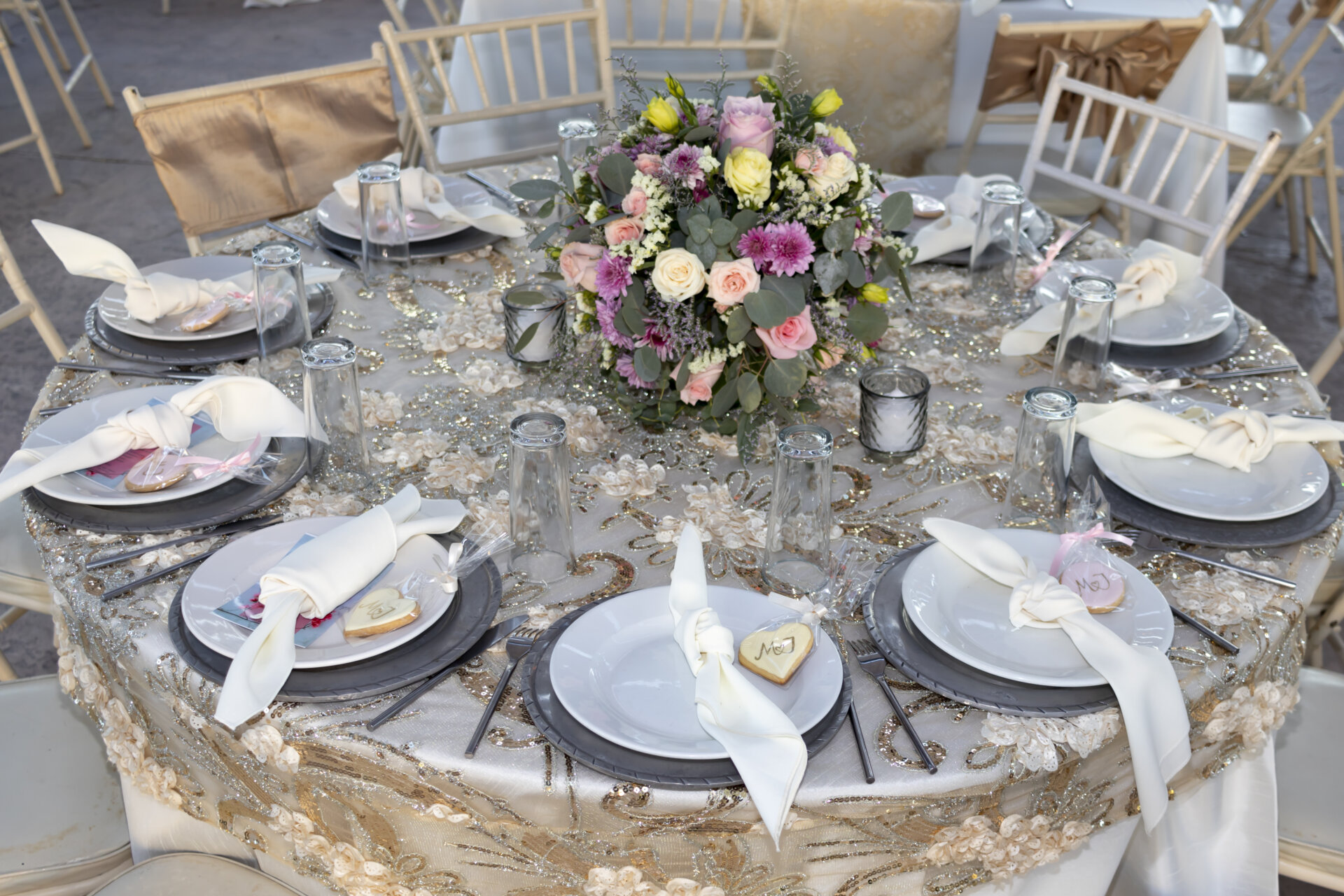
- The couple at a large round with parents or closest friends. A 72-inch round seats about 10; our guide on round table sizes for every guest count covers the rest.
For a very small celebration, you may not need a focal table at all. One long family-style table can be the whole reception, which is how a lot of our City Hall wedding reception ideas are set up.
What Each Table Takes to Build
A sweetheart table is a short list:
- One small round or a 4-foot rectangle from the table rental lineup
- Two chairs, often a step up from the guest chairs, such as gold ballroom chairs
- A floor-length linen, sometimes with a contrasting overlay
- A backdrop, a pair of wall panels or pipe and drape behind you
A head table takes more pieces: enough 6-foot or 8-foot rectangles for the full run, a chair for every seat, and linens that drop to the floor on the guest side, since everyone is looking at the front of that table all night. Many couples also put it on a platform stage with steps and a railing, plus a backdrop long enough to cover the whole length. If you’re tying it into a wider design, our notes on choosing wedding seating help match the focal table to the guest chairs.
Logistics follow the size. In a city venue, a raised head table means platform sections, steps and railings coming up the freight elevator, so check the building’s delivery window and whether vendors need to supply a certificate of insurance. Backyard receptions bring a different headache: lawns are rarely flat, so a long row of tables on grass tends to rock from one end to the other, while a sweetheart table on a small platform is easy to make steady.
Pro tip
Before you commit to a head table, pace it out at the venue walkthrough. Count your people, multiply by 2 feet, then walk that length along the wall you plan to use and leave 3 to 4 feet behind it for chairs and servers. If the line runs into a door or swallows half the dance floor, you have your answer.
Quick Answers
Who sits at the head table at a wedding?
Traditionally, the couple sits in the center with the maid of honor and best man on either side, and the rest of the wedding party extends outward. Some couples add partners of the wedding party, and some include parents, though parents more often host their own tables.
Is a sweetheart table rude to the wedding party?
No. Many attendants prefer sitting with their dates and friends. Just tell them ahead of time where they’ll be, ideally at tables close to yours, so it reads as a choice and not a demotion.
Where do the parents sit if you have a sweetheart table?
Usually at their own tables near the front, each surrounded by family and friends they’d want to spend the evening with. Divorced parents can each get their own table, which tends to make for a calmer night.
How long should a head table be?
Plan on about 2 feet of table per person, all seated on one side. A quick estimate: number of people times 2 equals feet of table. Twelve people need about 24 feet, which is three 8-foot tables.
Which is better for a wedding, a sweetheart table or a head table?
For a wedding, choose a sweetheart table if your party is large, partners need seats, or family tensions run high. Go with a head table if your party is small, your room has the wall, and you want your friends close for the toasts.
Sit Where You’ll Enjoy It
You’ll spend a few hours at whichever table you choose, so pick the one where you’ll actually have a good time, then let the room, the linens and the backdrop follow. Not sure how many tables your head table needs, or whether a riser will fit? Send us your floor plan. Our family-run crew has spent over a quarter century setting up reception rooms around the New York area, and we’d be glad to take a look.