


What you pay to rent tables and chairs comes down to a formula, not a single price: the per-piece rate for each item, times the number of pieces you need, plus delivery, setup and pickup, plus linens and any extras. Rates vary by company, date and location, so the only number you can plan around is a written, itemized quote. That’s also why two quotes for the same backyard party can land far apart without either one being obviously wrong, and this guide shows you exactly what goes into a quote and which line items move your total.
The Cost Formula Behind Every Quote
Strip any table and chair rental quote down and you’ll find the same structure underneath it:
- Chairs: quantity times the per-chair rate for the style you picked.
- Tables: quantity times the per-table rate, which depends on shape, size and finish.
- Linens: usually one tablecloth per table, priced by size and fabric.
- Service: delivery, setup, breakdown and pickup, sometimes listed as one charge and sometimes split out.
- Add-ons: anything beyond seating and tables, such as a bar, a dance floor or heaters.
- Conditions: damage waivers, taxes, minimum orders and any surcharges for stairs, long carries or tight time windows.
When two quotes look far apart, the gap almost always traces back to one of these lines. One company may fold delivery into the item rates while another lists it separately. One may quote padded folding chairs while the other quoted chiavari. Lining the quotes up line by line is the fastest way to confirm both companies are pricing the same order.
Why Chairs Usually Drive the Total
Most people expect tables to be the big expense, since they’re the bigger objects. In practice, chairs tend to carry the bill, and the reason is simple arithmetic: you need one chair per guest, but only one table for every 8 to 10 guests.
At a 120-guest dinner, that’s 120 chairs against roughly 12 to 15 tables. Even if a table rents for several times what a chair does, the chair line has eight to ten times as many units. Upgrade the chair style and that difference gets multiplied 120 times. Upgrade the table style and it gets multiplied 12 or 15 times.
So if you’re trying to control the budget, the chair decision is where your choices have the most leverage.
The 8 Factors That Set the Price
1. Chair style
Rental rates generally rise as you move from basic folding chairs toward event-specific styles. The exact rates are set by each company, but the general order is fairly consistent across the industry. If you’re still deciding on a style, our guide to choosing what type of chairs to rent covers comfort and look in more depth.
Here’s how the common styles compare, from least to most expensive:
- Basic folding chairs cost the least. They suit casual parties, backyard gatherings and overflow seating, and because they’re easy to stack and carry, they can help on sites with difficult access.
- Resin or wood folding chairs run low to moderate. They work well for garden ceremonies, daytime events and showers, and they look dressier than basic folding chairs without the premium of specialty styles.
- Chiavari (ballroom) chairs fall in the moderate to higher range and show up most at wedding receptions, galas and formal dinners. They’re often paired with a seat cushion, so ask whether cushions are included.
- Cross back, Napoleon and Orleans chairs are also moderate to higher. Hosts pick them for rustic, vintage or designed receptions, and since they’re usually chosen to be seen, they’re often left uncovered.
- Ghost chairs in clear acrylic sit in the same moderate to higher range and fit modern spaces and smaller formal dinners. They show scuffs and fingerprints, so handling matters.
- Benches vary in price and suit long farm-table dinners and ceremonies. One bench replaces several chairs, so compare per seat, not per piece.
That last point applies everywhere: always convert to cost per seat. A bench that seats three should be compared with three chairs, not one.
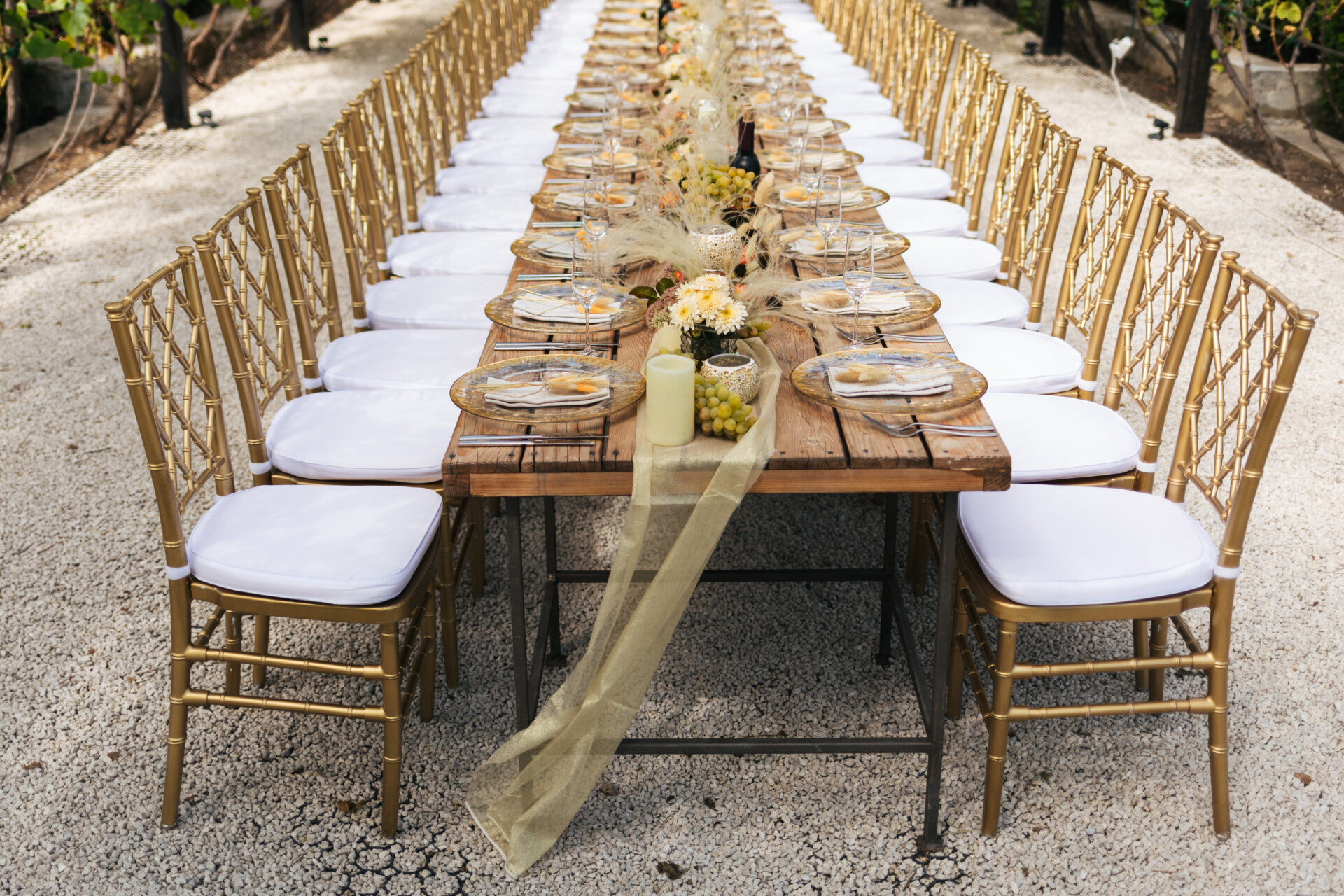
Color can matter too. Chiavari chairs come in several finishes, and a specific color like gold ballroom chairs may be in higher demand on popular dates, so it’s worth asking about availability early if you’ve set your heart on one finish.
2. Table type and size
Standard rounds and rectangular banquet tables are the workhorses of the rental world and usually the most economical. Rustic wood farm tables, serpentines, half moons and other specialty shapes generally rent for more.
There’s an offset worth knowing about: a rustic wood table is usually meant to be seen, so many hosts skip the tablecloth or use only a runner. That removes a linen line from the quote. Price the wood table plus no linen against a standard table plus a floor-length cloth before you assume the plain table is cheaper.
Size changes your table count, which changes everything attached to it. Here’s the math for 120 seated guests:
- A 60-inch round measures about 188 inches around its edge. Split among 8 guests, each person gets close to 23.5 inches of space; squeeze in 10 and the share falls below 19 inches, which feels tight for a plated dinner. At 8 per table, 120 guests fill 15 tables.
- A 72-inch round measures about 226 inches around. Ten guests at that size each get about 22.6 inches, nearly the same elbow room as a 60-inch round at 8. At 10 per table, 120 guests fill 12 tables.
Going to 72-inch rounds cuts three tables, three tablecloths and three centerpieces from the order. The trade-off is floor space, since each larger table and its ring of chairs takes up more room. Our guide to round table sizes for every guest count lays out seating and spacing for each diameter.
3. How many pieces each guest needs
This is the factor people underestimate most. A guest at a casual party needs one chair and a share of one table. A guest at a wedding may need a ceremony seat, a spot at a cocktail table and a dinner chair, on top of a share of the service tables around the room.
The difference between a party quote and a wedding quote is often less about the style of furniture and more about how many pieces each guest touches over the course of the event. The worked examples further down show this with real counts.
4. Linens
Every table you cover needs its own tablecloth, so the linen line follows your table count closely. Price depends on size, fabric and whether you choose a standard polyester or a specialty finish.
Fabric size comes down to the overhang. With a typical table height of 30 inches, a floor-grazing cloth needs 30 inches of fabric hanging off every edge, so you add 60 inches to each tabletop dimension:
- 60-inch round: a 120-inch round cloth (60 + 30 + 30).
- 72-inch round: a 132-inch round cloth (72 + 30 + 30).
- 6-foot banquet table (about 72 by 30 inches): a 90 by 132-inch cloth (30 + 60 for the width, 72 + 60 for the length).
Shorter lap-length cloths use less fabric and may cost less, but they show the table legs. You can browse sizes and colors on our linens page, and confirm the exact table dimensions before ordering so the cloth actually fits.
5. Delivery distance and site access
Getting 150 chairs from a warehouse to your room is real labor, and site conditions affect how much of it there is.
In Brooklyn and across the city, stairs and elevators matter most. A brownstone event in Fort Greene with a stoop and a parlor-floor reception means every chair and table gets carried by hand, and a loft may require a freight elevator reservation before the crew can bring anything up. Many rental companies charge for stairs, long carries or extra crew time, so describe your site honestly when you ask for a quote.
On Long Island and in New Jersey, distance and travel time play a larger role, and the access questions shift outdoors: how wide the side gate is, whether the truck can use the driveway, and how far the crew has to carry everything across the lawn to the setup spot.
6. Setup, delivery windows and pickup
A quote that includes delivery doesn’t always include setup. Some companies drop items at the door, while others place tables, open chairs and set them at each table. Ask which you’re getting, and whether breakdown is included at the end.
Timing can also affect cost. A flexible delivery window is easiest to schedule. A narrow window, an early-morning drop, a late-night pickup right after the last guest leaves, or a Sunday or holiday pickup may carry extra charges at some companies. If your venue only allows load-in during a specific two-hour slot, mention it upfront so the quote reflects it.
7. Event date and rental length
Saturdays in peak wedding months and the weeks around major holidays are when inventory gets tight. You may not pay more for the same chair on a busy date, but you may find your first-choice style or color unavailable, which pushes you toward a different option. Our article on when to book table rentals covers lead times in more detail.
Rental length matters too. Many companies price items per event for a standard rental window. If you need everything delivered Friday for a Sunday event, or kept over a weekend, ask how that’s priced before you assume it’s the same as a one-day rental.
8. Outdoor and public-space costs
Taking the event outside adds costs that have nothing to do with the furniture itself.
If your plan puts tables and chairs out on a public street or sidewalk in New York City, the city treats that as a Street Event, and the CECM frequently asked questions page explains that this kind of setup needs a permit through SAPO. Those permits can cost far more than the rentals: at the time of writing, the CECM fees page lists Street Event permits at $3,100 for small events, $11,000 for medium and $25,000 for large. Check the current fees and which category applies to you directly with the city. A private backyard is a different situation, though towns and villages on Long Island and in New Jersey may have their own rules for larger gatherings, so confirm with your local municipality.
Weather adds its own line items. Cool evenings may call for portable heaters. Soft lawns can swallow chair legs and make dancing difficult, which is where a dance floor or a platform stage earns its place in the budget. Outdoor furniture also faces more risk of damage or soiling, which is one reason some companies offer or require a damage waiver.
A Party Order Compared With a Wedding Order
The examples below use piece counts rather than prices, because counts are what you control. Multiply each line by the rates in your quote to see your total.
A 40-guest backyard party
Seating everyone at 6-foot banquet tables (about 8 per table with guests on the ends):
- 40 folding chairs
- 5 six-foot tables for seating
- 2 six-foot tables for the buffet
- 1 table for drinks and dessert
- 8 tablecloths, one per table
That’s 56 pieces in total: 40 chairs, 8 tables and 8 linens. Chairs account for about 71 percent of the items (40 of 56), which is why the chair style choice matters so much even for a small party. If the yard gets afternoon sun, an umbrella table or two for older guests is a common add-on.
A 120-guest wedding reception
For 120 guests plus the couple at a sweetheart table, with dinner at 72-inch rounds seating 10:
- 122 dinner chairs (120 guests plus 2 for the couple)
- 12 seventy-two-inch round tables
- 1 sweetheart table
- 10 highboy cocktail tables for cocktail hour
- 4 service tables (escort cards, cake, gifts, DJ)
- 27 tablecloths, one for each of the 27 tables
- 120 ceremony chairs, if the ceremony is in a separate space
With a separate ceremony space, the order comes to 296 pieces: 242 chairs, 27 tables and 27 linens. That’s more than five times the party order for three times the guests, and the reason is visible in the list: each wedding guest uses two chairs (ceremony and dinner) plus a share of the cocktail and service tables.
If the ceremony chairs are moved into the reception space during cocktail hour (a “flip”), the order drops to 176 pieces: 122 chairs, 27 tables and 27 linens. That saves 120 chair rentals, but it requires a time gap, a crew to do the moving and a venue that allows it. Ask who handles the flip and whether it’s priced as labor.
A bar is often part of a wedding order as well. It’s a single line item, but it changes the look of the room more than most furniture does, so it’s worth pricing alongside the tables and chairs.
How to Price Out Your Own Order
Before you request quotes, build a simple list so every company is pricing the same thing. Work through these lines and fill in quantities from your own guest count:
- Dinner chairs: one per seated guest, plus a few extras. Confirm the style, the color and whether cushions are included.
- Ceremony chairs: one per guest, or zero if you flip. Check whether flip labor is included or extra.
- Dining tables: guests divided by seats per table, rounded up. Confirm the exact size and shape.
- Service tables: count each station, such as the buffet, cake, gifts and escort cards, and confirm the size of each.
- Cocktail tables: a rough guide is one for every 10 to 12 standing guests. Confirm the height and top size.
- Tablecloths: one per table you plan to cover, with the drop length and fabric spelled out.
- Delivery and pickup: usually one of each unless the order is split. Ask about time windows and any after-hours charges.
- Setup and breakdown: full placement or drop-off only. Find out what the crew does on arrival and at the end.
- Access surcharges: stairs, elevators and long carries. Ask whether your site triggers any.
- Damage waiver and tax: applied to the order total. Check whether the waiver is optional or required.
Round up when you divide guests by seats. For example, 75 guests at tables of 8 is 9.4 tables, so you need 10. Then add a small buffer of chairs for last-minute guests and vendors who need to sit.
If you’re comparing several companies, our article on what to look for in a table and chair rental service covers reliability and service questions that don’t show up on a price sheet.
Ways to Lower the Total Without Guests Noticing
A few changes reduce cost without making the event look stripped down:
- Use the premium chair only where people sit longest. Dinner chairs get the most attention; ceremony chairs are used for 20 or 30 minutes, so a resin or wood folding chair may be fine there.
- Choose larger tables. As shown above, moving 120 guests from 60-inch to 72-inch rounds removes three tables and three tablecloths.
- Skip linens on wood tables, since a rustic table with a runner can replace a standard table plus floor-length cloth.
- Flip the ceremony seating if your timeline and venue allow it.
- Bundle everything into one delivery. A single drop and a single pickup usually cost less than separate runs for tables, linens and a bar.
- Give the crew easy access. Reserving the freight elevator or clearing the side gate before they arrive saves carry time.
- Book early so you can get the economical option you want instead of whatever’s left.
One thing not to cut is the chair count. Running short on seats at dinner is far more noticeable than a simpler chair style.
Questions That Make a Quote Comparable
Before you accept a quote, get clear answers to these, in writing if possible:
- Is delivery, setup, breakdown and pickup included, or listed separately?
- Are there charges for stairs, elevators or carrying items a long distance from the truck?
- What delivery and pickup windows are included, and what does a specific time cost?
- How long is the rental period, and what happens if the event runs late?
- Is a damage waiver optional or required, and what does it cover?
- Do linens need to be returned in a certain way, such as shaken out and bagged?
- Can the company provide a certificate of insurance if the venue or building asks for one?
- Is there a minimum order, and does your order meet it?
Once two quotes answer the same questions, you’ll usually find the price gap shrinks or the reason for it becomes obvious.
Get the Count Right, Then Ask for Numbers
The most accurate answer to how much tables and chairs cost for your party or wedding comes from a complete list: guest count, chair style, table sizes, linens, site access and timing. Put those together using the counts above, and any quote you receive will be easy to check. Our family has been running B&B Party Rentals out of Brooklyn for more than 25 years, handling delivery, setup and pickup of event furniture, and if you send over your list, we’ll price each line for you. You can request a quote through our contact page whenever your plans are ready.