


Say you’ve booked a big rectangular hall for a milestone birthday, and it suddenly hits you that the caterer’s prep tables, the dance floor and your aunt’s quiet dinner table will all share one wide-open box. A bamboo room divider handles that cheaply: a row of folding bamboo screens can wall off a prep area or frame a lounge, giving each part of the party its own edges. The catch is that bamboo is light, short and flammable unless treated, so it’s good for visual separation and bad at blocking sound or holding back a crowd.
That’s the honest version. Here’s how to get the most out of it.
The Kinds of Bamboo Dividers You’ll Find
The phrase covers a few different products, and they behave very differently in a party room.
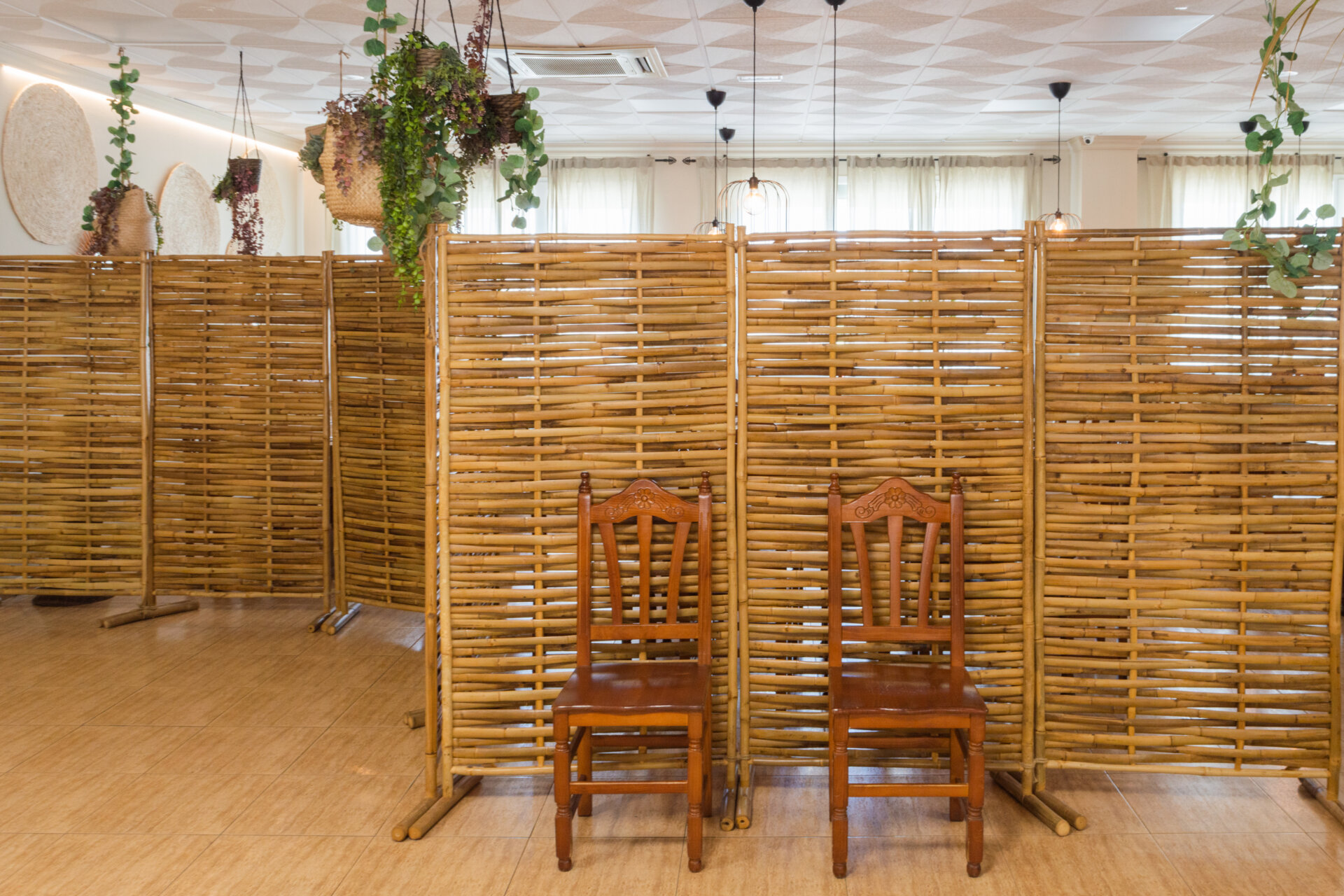
- A folding bamboo room divider is the classic freestanding screen: three or four hinged panels that stand up in a zigzag. This is what most people picture, and it’s the easiest to use at an event because it needs nothing to hold it up.
- A natural bamboo screen is the same idea built from unfinished poles lashed with cord instead of stained, flat slats. It reads more rustic and usually lets more light through the gaps.
- A bamboo curtain that works as a room divider is either beaded strands or a roll-up blind that hangs from a rod or ceiling track.
- Bamboo fencing is garden material sold in rolls, poles wired together side by side.
Can you use bamboo curtains as a room divider? Yes, if you have something to hang them from. That’s the problem at most rented venues: you can’t drill into the ceiling, so a curtain needs a freestanding frame strong enough to carry it, and you should confirm with whoever supplies the frame that the extra weight is fine.
A bamboo fence works as a divider if you treat the roll as a skin, not a wall. Zip-tie it to posts or a sturdy frame every foot or so, top and bottom. A loose roll wants to curl back on itself, and cut ends can be sharp, so wear gloves and tuck the edges toward the side guests won’t touch. Leaning a fence roll against a wall and hoping is how it ends up on someone’s dinner plate.
Check These Before Screens Go Into the Venue
- Measure the length of each run you want to cover, in feet, and note the ceiling height
- Confirm the screens are treated with a fire retardant, and get paperwork if the seller has it
- Ask the venue whether decorative partitions are allowed and where
- Do a wobble test: push the top corner lightly and see if the screen rocks
- Keep exits, exit signs and fire extinguishers visible and unblocked
- Work out how the screens get in the building and up to the room
- Decide who sets them up, and who takes them home at the end of the night
A stack of folding screens is easy to carry, but if they arrive with a rental delivery at a building that books its freight elevator by time slot, let the building know ahead of time.
Exits are the other non-negotiable. A screen that hides the caterer’s mess also tends to hide the emergency door behind it, and the fire marshal won’t care how nice it looks.
Sketch the Zones Before You Place a Single Screen
Dividers are the last thing to plan, not the first. Figure out how much floor each activity needs, draw those blocks on paper, and only then decide where a line between them should go. Our guide to how much space per guest you need covers the square footage for dining, dancing and standing room, and it’s worth running those numbers before you buy six screens you don’t have room for.
A useful habit: mark every divider on your sketch as a thick line about two feet wide. That’s roughly how much depth a zigzagged folding screen eats, and it’s floor you can’t put a chair on.
6 Ways to Zone a Party With Bamboo Screens
Hide the Caterer’s Staging Area
This is the most common use, and the most useful. Caterers need a spot for racks, coolers, empty boxes and the general chaos of plating. A line of screens across one end of the room gives them that space without guests staring at it all night. Leave a clear opening at least four feet wide so staff with trays aren’t squeezing sideways.
Put Some Distance Between Dinner and the Dance Floor
A partial screen line between tables and the dance floor gives older guests a sense of their own space. Be realistic, though. Bamboo slats with gaps between them do almost nothing for sound. If the goal is a quieter dining area, distance and speaker placement will do more than any screen.
Build a Lounge Corner for People Who Want to Talk
Two or three screens angled across a corner turn it into a lounge. Add a few cocktail tables or a bistro set, keep the lighting softer there, and you’ve made a spot where people can actually hear each other. Our post on the do’s and don’ts of event lighting has ideas for making a corner like that feel separate.
Back the Bar or Dessert Table
A bar against a blank wall looks like a bar against a blank wall. Two bamboo screens behind it give it a frame and hide the cases of mixers stacked underneath. If you’re arranging a bar rental for your party, leave space between the back bar and the screens so the bartender isn’t knocking them over every time they turn around.
Make a Coat Check Nook by the Door
In winter, coats pile up fast. A rolling coat rack tucked behind a screen or two near the entrance keeps a wall of parkas out of every photo. Just don’t narrow the entry path; guests arriving in a group need room to get in and out.
Mark Off a Kids’ Corner
Screens can define where the kids’ table and activities live, which helps parents keep track of them. Treat this as a visual boundary only. A lightweight screen will not stop a determined six-year-old, and a screen that tips onto a child is the last thing you want. Weight the feet or skip the screens on this one.
Bamboo Screens, Weighed Up
Bamboo has a lot going for it at parties, and a few real drawbacks. Here’s the short version before you commit.
Pros
- Light enough for one person to carry and set up
- Folds flat, so a stack fits in a car trunk
- Warm, natural look that suits garden parties, tropical themes and rustic setups
- Lets some light through, so zones don’t feel like closets
- Inexpensive to buy compared with most custom partitions
Cons
- Most screens stand around head height, so they won’t hide anything tall
- Light weight means they tip in drafts, wind and crowds
- Gaps between slats block very little sound
- Untreated bamboo burns readily, which is a real issue indoors
- Covering a long run takes a lot of screens, and the zigzag eats floor space
The pattern is clear enough: bamboo is good for short runs, corners and backdrops. It struggles with long, tall walls and with anything that needs to look solid from across the room.
Outdoors, the weight issue gets worse. At a backyard party in Nassau County, an afternoon breeze off an open lawn will push a folding screen over in seconds unless the feet are weighted or staked. If you’re planning an outdoor event, our outdoor party rental checklist covers the wind and weather side in more detail.
Fire Safety Is the Part People Skip
Bamboo is grass, and dry grass burns. Untreated bamboo ignites and burns more readily than treated bamboo, which is why there’s published research on boric acid and borax treatments for bamboo aimed at improving its fire resistance. Our take for party purposes: if bamboo is going indoors as decor, it should be treated with a flame retardant. Many decorative screens are sold without any treatment at all.
That matters because fire rules already pay attention to combustible decor. Depending on the setup, New York’s fire code may require certification that tent sidewalls and combustible decorative materials meet flame-propagation standards. Your party may not be in a tent, but plenty of venues apply similar thinking to anything decorative you bring in. Ask the seller for fire-test or treatment documentation, ask the venue what it requires, and keep screens well away from candles, heaters and chafing dish burners. What actually applies depends on the building, the type of event and the code in force, so read the code section yourself or check with your local fire department before you count on bamboo indoors.
When Panels, Drape or a Mechitza Do the Job Better
To be straight with you: B&B doesn’t rent bamboo screens. What we do rent are the things people often reach for once they realize bamboo can’t cover a 40-foot run or stand up to a dance floor crowd.
Wall panels and backdrops give you a taller, solid-looking wall and stand up better to bumps. Pipe and drape covers long distances quickly and hides back-of-house areas completely. For religious events, a mechitza is built for separating a room and is sturdier than any decorative screen. Display shelving can also act as a divider that does double duty for gifts or favors.
A lot of hosts mix the two: rented panels or drape for the long, practical runs like the kitchen wall, and their own bamboo screens for the lounge corner or behind the bar, where the look matters more than the coverage. Before you book anything, run through our list of questions to ask your party rental provider, especially around delivery windows and who handles setup.
A 30 by 60 Foot Hall, Divided Up
Here’s how the math plays out in a typical rented hall in the Bronx, say a 30 by 60 foot room for 100 seated guests.
The whole room is 30 times 60, or 1,800 square feet. The caterer wants a strip 10 feet deep across the 30-foot short end. That’s 300 square feet, leaving 1,500.
The screen line runs the full 30 feet, minus a 4-foot service opening, so you need to cover 26 feet. Check the listing for your screens, but suppose each one covers about 5 feet when zigzagged. Twenty-six divided by 5 is 5.2, so you need 6 screens, with a little overlap. At about 2 feet of depth, that 26-foot line takes roughly 52 square feet, which brings you down to about 1,450.
Dining at roughly 10 square feet per seated guest takes 1,000 square feet for 100 people. That leaves about 450. A 12 by 12 dance floor is 144 square feet, leaving around 300 for the bar, any lounge corner and the walkways between them. That’s tight. Something has to give: the lounge corner probably goes, or the caterer’s strip shrinks to 8 feet deep (240 square feet instead of 300, freeing up 60), or the guest list gets a trim. Better to learn that on paper than on the day.
Setting Up the Dividers on Party Day
Screens go in late in the setup, after the big pieces are placed. Here’s the order that avoids moving everything twice.
- Place the large items first. Get tables, the bar, the dance floor and any staging in position before a single screen comes out of the box.
- Tape the lines. Use painter’s tape on the floor to mark where each screen run goes, matching your sketch. Check that no line crosses an exit path.
- Stand the screens in a slight zigzag. A flat-open screen falls over; an angled one stands. Aim for a consistent angle so the line looks deliberate.
- Weight or secure the feet. Sandbags, discreet weights or zip ties to a fixed object all help. Outdoors, this isn’t optional.
- Walk the room as a guest. Come in through the front door and look for gaps that show the kitchen, screens that wobble when brushed, and openings too narrow for a server with a tray.
- Brief the staff. Tell the caterer and anyone working the event which openings are for service and which screens shouldn’t be moved.
At the end of the night, fold screens before the breakdown rush starts. They’re the first thing to get stepped on when tables start moving.
Draw the Lines, Then Fill the Rooms
A bamboo room divider is a good tool for small jobs: a corner here, a backdrop there, a kitchen hidden from view. Plan the zones with real numbers, treat fire safety seriously, and don’t ask a light screen to do a wall’s job.
If your layout needs longer, taller or sturdier separation than bamboo can give, we’re happy to talk through panels, pipe and drape or a mechitza for your space.