


Short version: choose a paisley tablecloth by its colors first and its size second, then keep everything else on the table plain. Paisley is a busy pattern, so it only works when at least one shade in the print matches your palette exactly and the motif scale suits the table it covers. Get those two calls right and paisley looks deliberate. Get them wrong and the reception looks like a 1970s den.
Below is how to make each call, with sizing numbers you can hand to a rental company and a sample order for a 120-guest room.
Start With the One Color You Can’t Lose
Every paisley print has a dominant color, usually the background or the biggest teardrop shapes, plus two or three supporting shades. Your job is to find the one that already belongs to your event and treat it as the anchor. That’s the color you repeat in napkins, flowers or a ribbon on the chairs, so the cloth looks connected to the room instead of dropped into it.
The Lightner Museum’s wedding team suggests aiming for three to five coordinating colors with at least one neutral. Here’s the catch with paisley: a single cloth can carry four colors on its own. In practice, the tablecloth often becomes your palette, and everything else should pull from it rather than add to it. If you already have a palette locked in, hold a swatch of each color against the print. If more than one of your colors is missing from the cloth, keep shopping.
Zola’s advice on choosing wedding colors points out that season and venue should shape the palette, and that keeping hues broad makes linens easier to match. That applies doubly here. A paisley built around a classic navy is easy to work with. One built around a very specific teal will fight your florist and your bridesmaids, and possibly the carpet.
The venue counts as part of the palette too. A Tribeca loft with exposed brick and black window frames already supplies warm reds and dark accents, so a red or burnt orange print looks like it was chosen for the space. A white-walled Manhattan gallery or event room gives you a blank slate, which is when bolder colorways can carry the decor without competing. For more on building the overall scheme, see our guide to choosing an event color palette.
Paisley Colorways and Where They Fit
Paisley comes in nearly every combination, but a handful show up again and again at parties and weddings. Each one carries a mood, so pick the one that matches the event you’re actually throwing.
- Red reads warm, rich and festive. It suits winter parties, holiday dinners, and mehndi and sangeet nights, and it pairs well with gold accents, ivory napkins and dark wood.
- Burnt orange feels earthy and autumnal. Use it for fall weddings, Thanksgiving or rustic rehearsal dinners, alongside cream, olive green and rustic wood tables.
- Navy blue and white looks crisp and a little preppy, which fits summer parties, garden events and showers. Pair it with white chairs, greenery and silver.
- Grey stays quiet and neutral. It works for corporate events and flower-heavy weddings and goes with blush, metallics and almost anything else.
Red and burnt orange paisley
A red paisley tablecloth is the bold choice. It warms up a room fast and pairs naturally with candlelight, which is why it shows up so often at winter dinners and evening celebrations. Use it on fewer tables than you think you need. Burnt orange paisley does similar work for fall but feels more relaxed, and it looks especially good next to unfinished wood and cream linens. Both prints have a lot going on, so stick with plain napkins and keep the centerpieces simple.
Navy blue and white paisley
Navy blue and white paisley tablecloths are the easiest place to start if you’re nervous about pattern. Two colors means the print reads cleaner from across the room, and white napkins match automatically. A rectangular blue paisley tablecloth also holds up well on long family-style tables, where a busier print would turn into visual noise over 16 feet of table.
Grey paisley
A grey paisley tablecloth is the safe bet, in the good sense. Tone-on-tone grey gives you texture without a loud color, so it plays well with heavy florals, metallic chargers or a bright accent color you want to stand out. If you love paisley and your partner doesn’t, this is usually where you both end up.
Match the Print Scale to the Table
This is the step most people skip. Paisley motifs range from small, tight repeats to big teardrops you could trace a hand around, and the size of the table decides which one works.
Big motifs need room. A 120-inch cloth on a 60-inch round hangs all the way down to the floor, and that long fall of fabric gives large shapes space to show their full curl. Put that same print on a small cocktail table or a 30-inch round and the edge chops the motifs in half, so guests see random fragments of teardrops instead of a pattern.
Consider where the print actually shows on a dinner table, too. Once the plates, glasses and centerpiece go down, most of the tabletop disappears. What guests notice is the fabric hanging over the edge. That’s an argument for floor-length cloths if paisley is your main decor, because a lap-length cloth leaves only a short band of pattern visible, plus the table legs.
- Large-scale paisley: floor-length cloths on 60-inch and 72-inch rounds, long banquet tables, cake and dessert tables
- Small-scale paisley: smaller rounds, sweetheart tables, overlays and runners
- Solid instead: highboy cocktail tables, where a fitted cover or a tied cloth hides most of the print anyway
Round paisley tablecloths have one more advantage: most all-over paisley prints don’t have a top or bottom, so you don’t have to worry about orientation the way you would with a striped or bordered design. If the print does have a border, make sure the border lands at the hem, where people will see it.
Tablecloth Sizes for Standard Event Tables
The formula is simple: table size plus twice the drop you want. Most round and banquet tables measure roughly 30 inches from floor to tabletop, which means that’s also the drop a cloth needs to reach the floor. Something closer to 15 inches lands around the lap of a seated guest.
For a 60-inch round, that works out to 60 + (2 \u00d7 30) = 120 inches for floor length, and 60 + (2 \u00d7 15) = 90 inches for a shorter drop. Here’s how the common sizes shake out:
- 48-inch round: a 90-inch cloth hangs 21 inches on each side, while a 108-inch cloth covers the full 30 inches down to the floor.
- 60-inch round: go with 90 inches for a 15-inch drop or 120 inches if you want the fabric to touch the floor (a 30-inch drop).
- 72-inch round: 102 inches gives you a 15-inch drop, and 132 inches gets you to full length at 30 inches.
- 6-foot banquet (30 x 72 inches): 60 x 102 inches for a 15-inch drop, or 90 x 132 inches for a 30-inch, floor-length drop.
- 8-foot banquet (30 x 96 inches): 60 x 126 inches for a 15-inch drop, or 90 x 156 inches to cover all 30 inches to the floor.
If you’re still deciding on table sizes, our article on round table sizes for every guest count covers seating capacity, and the guide to how many tablecloths you need walks through counting cloths for guest, buffet and side tables.
Decide How Much Paisley the Room Gets
Paisley on every table is a strong look, and in a smaller room it can work. In a big ballroom, 15 or 20 patterned tables tend to blur into one busy carpet. A few other approaches give you the pattern without the overload.
The most forgiving option is to alternate tables: paisley on every other guest table, solids in your anchor color or a neutral on the rest. It reads as planned from any spot in the room.
You can also layer. Put a floor-length solid cloth down first, then lay a square paisley overlay on top so the corners drop over the edge. You get the pattern up where people see it while the solid keeps the room calm.
Or save paisley for feature tables only, such as the cake table, dessert display, sweetheart table or welcome table, and keep guest tables solid. This is the move if paisley ties into a theme, like a bohemian shower, but you don’t want it everywhere.
Runners are the lightest touch of all: a narrow paisley strip down the center of a long banquet table over a solid cloth. Just remember the centerpieces will cover a lot of it.
A Sample Order for 120 Guests
Say you’re hosting 120 guests at 60-inch rounds with floor-length cloths, alternating paisley and solid. A 60-inch round comfortably holds 8 guests and can squeeze in 10. At 10 per table, you need 120 \u00f7 10 = 12 tables. That’s a snug fit: the table’s edge measures about 188 inches around (60 \u00d7 3.14), so 10 guests get roughly 19 inches each. At 8 per table, each guest gets about 23.5 inches, but you’d need 120 \u00f7 8 = 15 tables. We’ll go with 12 for this example.
- Guest tables: 6 paisley 120-inch rounds and 6 solid 120-inch rounds
- Cake table (6-foot banquet): 1 paisley cloth at 90 x 132 inches, since it’s a feature spot
- Gift and card table (6-foot banquet): 1 solid cloth at 90 x 132 inches
- Napkins: 120 in the anchor color pulled from the print, plus a few extras for spills
That’s 7 paisley cloths and 7 solids, 14 in total. Order a spare of each if the budget allows, because somebody always knocks over red wine at table 4. Before you confirm, double-check that the solid you chose actually matches a color in the paisley in person, under indoor lighting, not just on a screen.
Keep Everything Else on the Table Quiet
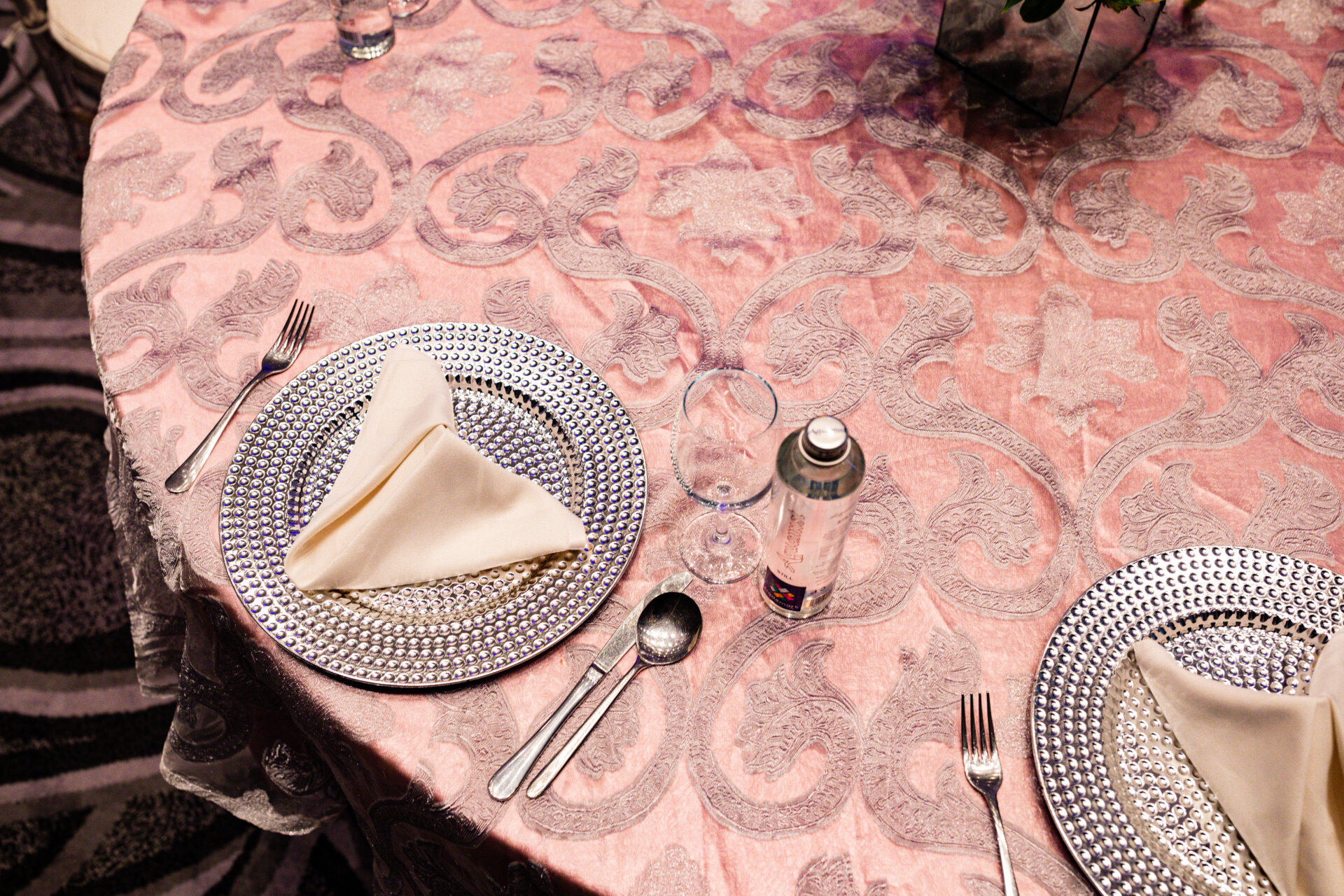
Once the cloth has a pattern, everything sitting on it should calm down. Solid napkins, simple white or clear dishware from your caterer, and low centerpieces with greenery or candles all let the print do its job. Patterned napkins on a patterned cloth almost never work, even when the colors technically match.
Chairs matter more than people expect, since they sit right next to that floor-length drop. Gold ballroom chairs look great next to red or burnt orange paisley, picking up the warmth in the print. Clear ghost chairs disappear against navy or grey and keep attention on the linens. Busy chair cushions or patterned sashes compete with the cloth, so skip them.
Is a Paisley Tablecloth Waterproof?
Usually not. Most rental tablecloths, paisley or solid, are polyester, which handles spills and washing better than many natural fabrics but still absorbs liquid. The waterproof paisley tablecloths you see at home goods stores are typically vinyl or coated cotton made for kitchen tables and picnics. They’re practical for a casual cookout, but they’re stiff, they don’t drape like event linens, and they look like what they are. Our breakdown of polyester and linen tablecloths covers how each fabric holds up.
Outdoors, weather is the bigger worry. Set the tables on a suburban lawn, out on Long Island or across the river in Jersey, and a lap-length cloth can turn into a sail the moment a breeze picks up, while floor-length cloths pick up grass and evening dew at the hem. Table clips help with wind. If the forecast looks wet, keep the paisley cloths for tables under cover and put solids on anything exposed, since a soaked pattern looks worse than a soaked solid.
Bring a Photo of the Room When You Ask
Paisley is one of those choices that looks completely different on a screen than it does on a table, so it pays to talk it through with someone who handles linens every week. B&B Party Rentals has been setting up events across New York City, Long Island and New Jersey for over 25 years, and we deliver, set up and pick up the tables and linens ourselves. Patterns and colorways in stock change, so get in touch with our team with your guest count, your table sizes and a photo of the venue, and we’ll tell you what we have that fits.